


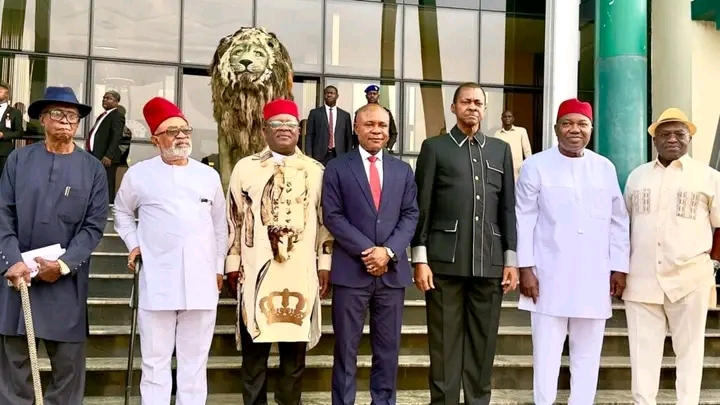
“South-East Ex-Governors Launch Strategic Forum, Applaud Tinubu’s Infrastructure Push as Regional Development Debate Deepens”
Former governors from Nigeria’s South East region have formally unveiled a new political and developmental platform aimed at strengthening regional cooperation, supporting incumbent state leaders, and advancing long term economic growth across the zone. The initiative, known as the South East Former Governors Forum, is positioned as an advisory and advocacy body focused on policy continuity, infrastructure expansion, and regional integration.
The forum, comprising past governors from the five South East states, said its creation responds to growing calls for experienced leadership voices to contribute to governance discussions beyond active political office. Members emphasized that the platform would provide strategic guidance to serving governors while promoting unity, economic planning, and coordinated development initiatives across Abia, Anambra, Ebonyi, Enugu, and Imo states.
Speaking during the unveiling, representatives of the group commended President Bola Ahmed Tinubu’s administration for ongoing infrastructure investments nationwide, noting that improved transportation networks and federal projects could enhance economic connectivity between the South-East and other regions of Nigeria. The former governors argued that sustained infrastructure development remains critical to unlocking industrial growth, improving trade logistics, and attracting private investment to historically underserved areas.
They further stressed that collaboration between federal and state governments would be essential to addressing longstanding challenges in the region, including road rehabilitation, security concerns, youth unemployment, and access to investment capital. According to the forum, leveraging the institutional experience of former leaders can help bridge policy gaps and encourage continuity in governance priorities regardless of political transitions.
Political analysts view the emergence of the forum as part of a broader trend in Nigerian politics, where former officeholders increasingly organize into policy advocacy blocs to influence governance discourse and regional development strategies. Observers say such bodies can serve as stabilizing platforms if they maintain non-partisan engagement and focus on development outcomes rather than political rivalry.
The development also comes amid renewed national conversations around equitable infrastructure distribution and regional inclusion under Nigeria’s current economic reform agenda. Analysts note that endorsements from influential political figures may strengthen federal-regional cooperation but also invite scrutiny regarding measurable impacts on local communities.
While reactions across political circles remain mixed, stakeholders broadly agree that sustained dialogue between past and present leaders could contribute to more coordinated planning and improved policy execution if institutionalized effectively.