


A pledge by opposition leaders to present a joint presidential candidate against President Bola Tinubu in 2027 has drawn sharply divided responses from political parties and stakeholders.
At a summit in Ibadan on Saturday, frontline opposition figures in the African Democratic Congress, ADC, and a faction of the People’s Democratic Party, PDP, vowed to unite behind one candidate to challenge the All Progressives Congress, APC, next year. The meeting, hosted by Oyo State Governor Seyi Makinde, was attended by former Vice President Atiku Abubakar; former Anambra State Governor Peter Obi; former Rivers State Governor Rotimi Amaechi; former Osun State Governor and factional ADC National Secretary Rauf Aregbesola; factional ADC National Chairman Senator David Mark; factional PDP National Chairman Tanimu Turaki; and others.
The APC, FCT Minister Nyesom Wike, Aviation Minister Festus Keyamo, and African Action Congress convener Omoyele Sowore dismissed the plan as unworkable.
The APC condemned Governor Makinde’s comments at the summit, accusing him of invoking “Operation Wetie” — the violent political crisis in the old Western Region during the First Republic — to incite unrest. APC National Publicity Secretary Felix Morka said Makinde’s remarks were “reckless, and a clear and present threat to peace and national security.” He added: “By his incitement to violence, Makinde has showed himself to be unworthy of the high office of Governor that he occupies.”
Morka described the opposition gathering as a “coalition of confusion” with no credible threat for 2027. He blamed Atiku Abubakar for “destroying” the PDP by taking its 2023 ticket, said Peter Obi’s “nomadic disposition” subverted Labour Party, and called the ADC “basically stillborn” after being taken over by “the same band of marauding opposition figures.”
Keyamo questioned how a merger would work for other offices on the ballot. “Team up under which banner? What happens to the candidates for other offices on both sides who will be on the ballot same day? Will they be campaigning against themselves and then campaign together for one presidential candidate?” he said. He cited the failed 2011 CPC-ACN merger talks as a warning: “These characters are in for a long night and a rude shock on the road to 2027.”
Sowore said he was invited but declined. “There is no need to pretend that the same men, and a few women, who held Nigeria to ransom for years… can suddenly reinvent themselves as champions of progress,” he said. He added that the AAC “will not be part of any charade designed to recycle failed political actors.”
The New Nigeria People’s Party, NNPP, called the initiative a “historic realignment of purpose.” National Publicity Secretary Ladipo Johnson said: “We are no longer just individual parties; we are a unified movement representing the collective will of Nigerians… proving that together, we possess the overwhelming mandate required to defeat the APC.”
Afenifere supported the idea but said the coalition must present a clear vision. National Publicity Secretary Justice Faloue said: “The question is what is the ideological position, not about personalities or ethnicity? It can’t be from the same ruinous neo-liberal economics… that increased poverty to 63%.” He added: “The single opposition must be from the opposite side of the political spectrum with pro-poor policies, not politicians moving from party to party for power, without a vision to uplift Nigeria.”
Former presidential aide Akin Osuntokun called it “a good idea, if it will serve to preclude what now seems to be an exorable drift to a one party state.” APGA founding chairman Chekwas Okorie said it was a “welcome development” but noted that implementation “remained to be seen,” citing APC’s control of 31 governors and majorities in the National Assembly.
Kingsley Ogga, National Chairman of an ADC faction aligned with 2023 candidate Dumebi Kachikwu, distanced himself from the Ibadan meeting. “I was not there… We are supposed to put our house in order first… The internal problems we have need to be resolved before we look outward,” he said.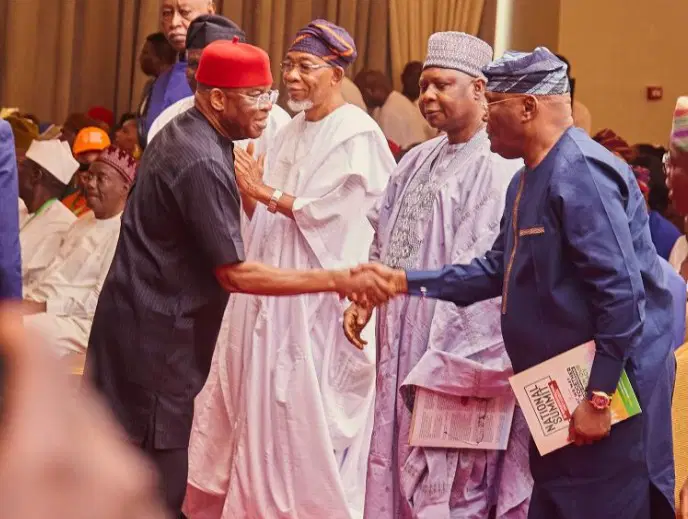
The Social Democratic Party, SDP, also said it was not part of the Ibadan Declaration. National Publicity Secretary Rufus Aiyenigba stated: “The whole idea… is largely built around only the ADC and the PDP… The SDP, as an undeniable front-line and crisis-free opposition political party, was deliberately sidelined