


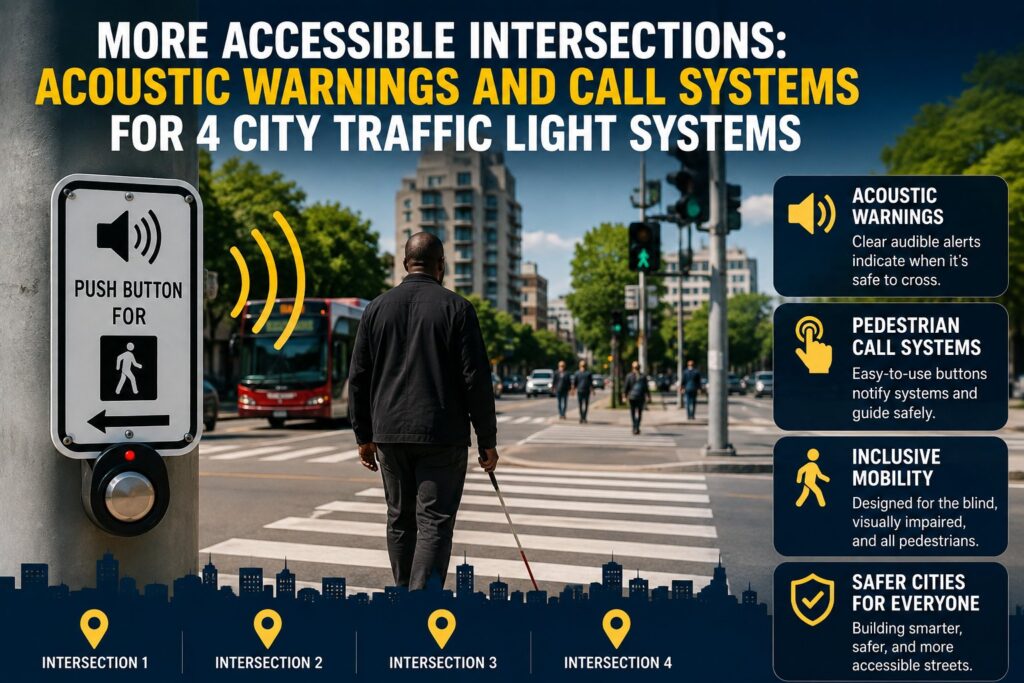
“Accessible Urban Mobility: Four City Intersections Upgraded With Acoustic Warning and Call Systems for Safer Pedestrian Crossings”
Efforts to make urban transport infrastructure more inclusive have received a major boost following the installation of acoustic warning and pedestrian call systems at four city traffic light intersections, a move designed to improve road safety and accessibility for people who are blind, visually impaired, and other vulnerable road users.
The upgraded traffic signal systems use audible alerts and pedestrian call features to indicate when it is safe to cross. The technology provides sound based guidance alongside traditional visual traffic signals, helping pedestrians navigate busy intersections more independently while reducing the risk of accidents.
The initiative forms part of a broader commitment by city authorities to create barrier-free public spaces and modernize transport infrastructure in line with international accessibility standards. Accessibility advocates have consistently emphasized that audible pedestrian signals play a crucial role in ensuring equal access to public spaces, particularly in densely populated urban environments where traffic noise and complex intersections can present significant challenges.
Globally, cities are increasingly adopting accessible pedestrian signal (APS) technology as governments seek to improve road safety and comply with disability inclusion policies. Recent projects in cities such as Chicago, Singapore and Vitoria Gasteiz have highlighted growing investments in acoustic traffic systems that provide audible and tactile guidance for pedestrians with visual impairments.
Transport and disability rights experts note that accessible intersections not only enhance safety for blind and low vision pedestrians but also benefit older adults, children, and visitors unfamiliar with local road layouts. Such upgrades are increasingly viewed as essential components of smart city development, ensuring that technological innovation delivers inclusive mobility for all residents.
As cities worldwide continue to invest in intelligent transport systems, the deployment of acoustic warning and pedestrian call technologies is expected to become a standard feature of future traffic infrastructure, supporting safer, more equitable, and more accessible urban environments.