

Abuja – Senate President Godswill Akpabio, human rights lawyer Femi Falana, SAN, NHRC Executive Secretary Tony Ojukwu, SAN, and retired Supreme Court Justice Abdu Aboki on June 9 called for stronger commitment from all stakeholders to deepen Nigeria’s democracy and ensure credible elections.
They spoke at the annual June 12 commemoration lecture in honour of the late Prof. Humphrey Nwosu, former Chairman of the National Electoral Commission who conducted the historic 1993 presidential election. The event, themed “Electoral Integrity and the Future of Credible Elections in Nigeria,” was organized by the National Human Rights Commission in collaboration with the Prof. Humphrey N. Nwosu Centre for Democracy and Human Rights.
Represented by Senator Adeniyi Adegbonmire, Chairman of the Senate Committee on Judiciary, Human Rights and Legal Matters, Akpabio said the National Assembly’s key role is to provide a legal framework that guarantees free, fair, transparent, and credible elections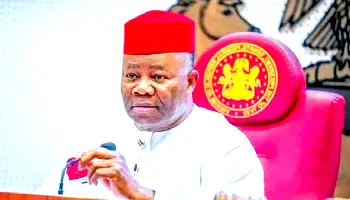

“The future of credible elections in Nigeria will depend, not only on technology and legal reforms, but also on character, leadership and institutional trust,” Akpabio said. “Nations rise when citizens believe in the fairness of their institutions.”
Falana, who was active in the struggle to ensure the June 12 election was held, praised the late Nwosu’s courage and integrity. He recalled that by April 1993, it was clear that General Ibrahim Babangida was reluctant to hand over power.
“If you want democracy next year at the elections, you must ensure that kidnapping, abduction of Nigerians, including children, stops,” Falana warned. “We can’t be talking of elections without addressing problems that will make elections impossible next year. If terrorism continues, if abduction of people continues, it will be difficult to have campaigns very soon.”
He also expressed disappointment that beneficiaries of the pro-democracy struggle are not doing enough to uphold electoral integrity and deliver democratic dividends.
NHRC Executive Secretary Tony Ojukwu described the lecture as more than a commemoration, calling it “a solemn reminder of the sacrifices made by courageous Nigerians in the struggle for democracy, constitutional governance, electoral justice, and the protection of fundamental human rights.”
Retired Justice Abdu Aboki argued that electoral integrity goes beyond technical fixes. “Electoral integrity is not merely a technical issue; it is a human rights issue, because it is about the right of every citizen to choose their leaders freely without fear of manipulation or disenfranchisement,” he said.
He noted that as citizens demand accountability and technology reshapes political participation, Nigeria must confront how to strengthen the sanctity of its electoral process.
The speakers agreed that achieving electoral integrity requires commitment from political parties, politicians, voters, security agencies, and electoral officials. They stressed that without security, public trust, and institutional accountability, democratic progress will remain fragile as Nigeria approaches the next election cycle.