


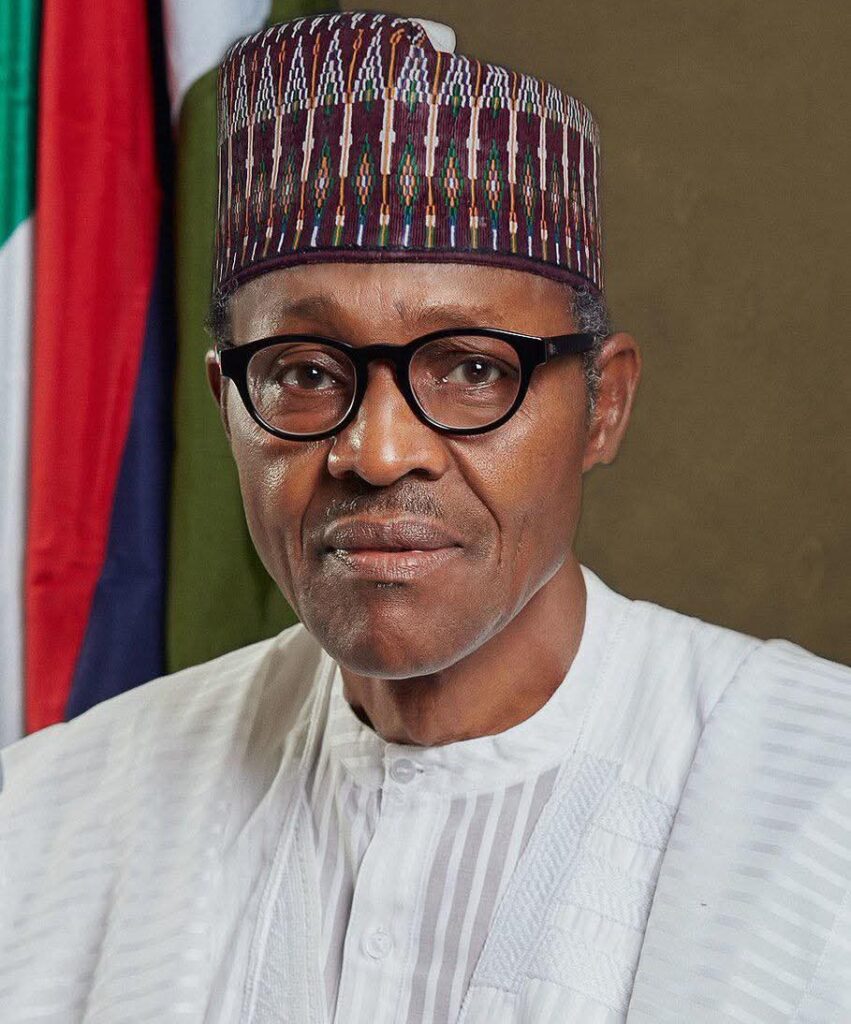
By Ikpommwosa Odigie
In the tapestry of Nigeria’s turbulent political history, few figures have cast a long and polarizing shadow as Muhammadu Buhari. From a decorated soldier to a military ruler, to an elected president and ultimately, a figure of fierce debate.
This is the comprehensive story of the man called ‘Mai Gaskiya’ by some, and a tyrant by others. This is Muhammadu Buhari’s Nigeria.
Muhammadu Buhari was born on December 17, 1942, in Daura, Katsina State, in Nigeria’s northwestern region. The 23rd child of his father, Mallam Hardo Adamu, a Fulani chief. Buhari’s early years were rooted in Islamic tradition and the agrarian culture of Northern Nigeria. He completed his secondary education at Katsina Provincial Secondary School before joining the Nigerian Army in 1961.
His military career spanned over two decades, including training at the Nigerian Military Training College, MONS, Officer Cadet School in Aldershot, United Kingdom, and the Defence Services Staff College in India. Buhari distinguished himself early, earning a reputation for discipline, loyalty, and hardline nationalism.
He served as Platoon Commander of the Second Infantry Battalion, Abeokuta in 1963, Officer Commanding 2nd Infantry Battalion during Nigeria’s Civil War from 1967 to 1970, Military Governor of the old North-Eastern State in 1975, Federal Commissioner (Minister) for Petroleum and Natural Resources from 1976 to 1978, and Chairman of the Nigerian National Petroleum Corporation between 1977 and 1978.
Away from military life, Muhammadu Buhari was a family man whose personal life, though largely private, shaped much of his public demeanor. He married twice in his lifetime. In 1971, he married Safinatu Yusuf, a reserved and soft-spoken woman born in 1952. Safinatu served as Nigeria’s First Lady during Buhari’s military rule from 1983 to 1985.
Their marriage produced five children: Zulaihat Buhari, Fatima Buhari, Musa Buhari, Hadiza Buhari, and Safinatu Lami Buhari. Their daughter, Zulaihat Buhari, tragically passed away in 2012 from complications related to childbirth in Kaduna.
Buhari and Safinatu divorced in 1988 after his removal from office and subsequent detention. Safinatu later died in January 2006 after battling diabetes.
In 1989, Buhari married Aisha Halilu Buhari, a native of Adamawa State, a trained cosmetologist and entrepreneur. Aisha Buhari would later become Nigeria’s First Lady from 2015 to 2023 and earned a reputation as one of the country’s most outspoken First Ladies.
The union produced five children: Halima Buhari Sheriff, Yusuf Buhari, Zahra Buhari-Indimi, Aisha Hanan Buhari, and Noor Buhari. Yusuf Buhari, the only surviving son, made national headlines in 2017 when he survived a near-fatal power bike accident in Abuja. Zahra Buhari-Indimi married billionaire Mohammed Indimi’s son, Ahmed Indimi, while Hanan Buhari pursued photography, graduating from Ravensbourne University in the United Kingdom.
Buhari was widely known as a strict, conservative father and a disciplinarian who valued modesty, discretion, and personal discipline within his family. His second marriage attracted public interest, especially as Aisha Buhari occasionally made bold and controversial political statements.
In 2016, she famously alleged in a BBC interview that her husband’s government had been hijacked by a cabal. Buhari, while on a state visit to Germany, reacted with his now infamous remark, “I don’t know which party my wife belongs to, but she belongs to my kitchen, my living room, and the other room.”
The comment sparked nationwide and international debates on gender equality and women’s roles in public life.
On December 31, 1983, Muhammadu Buhari led a military coup that toppled the civilian government of President Shehu Shagari, citing rampant corruption, economic mismanagement, and national insecurity.
At just 41 years old, Buhari became Nigeria’s military Head of State. His regime was characterized by what he called a “War Against Indiscipline,” a campaign to sanitize public life, enforce orderliness, and curb societal excesses. His tenure saw the public execution of armed robbers by firing squad, the introduction of Decree 4 which curtailed press freedom, retrospective capital punishment for drug trafficking, mass detention of politicians, journalists, and business elites without trial, and stringent economic austerity measures.
While some praised his anti-corruption drive and enforcement of discipline, others condemned his authoritarian rule. On August 27, 1985, Buhari was overthrown by his own Chief of Army Staff, General Ibrahim Babangida, bringing an abrupt end to a brief but unforgettable military dictatorship.
After his removal, Buhari largely withdrew from public life, only occasionally reappearing in national affairs. Under the regime of General Sani Abacha, Buhari was appointed to chair the Petroleum Trust Fund (PTF) in 1995, where he oversaw public infrastructure projects funded by Nigeria’s oil windfalls.
Many Nigerians credited him with running a relatively efficient and less corrupt PTF compared to other government agencies. Yet his austere, uncompromising personality continued to earn him both admiration and suspicion.
In Nigeria’s southern regions, Buhari was sometimes viewed as a northern supremacist, while in the north, he was often revered as an incorruptible patriot.
With the return of democracy in 1999, Muhammadu Buhari launched a political comeback. In 2003, he contested the presidential election under the All Nigeria Peoples Party (ANPP) but lost to Olusegun Obasanjo. In 2007, he ran again and was defeated by Umaru Musa Yar’Adua. Undeterred, Buhari contested for a third uptime in 2011 under the Congress for Progressive Change (CPC), a party he founded, but was defeated by incumbent President Goodluck Jonathan.
After three consecutive defeats, many political analysts wrote off Buhari’s chances, but the 2015 elections would ultimately reshape Nigerian history.
In an unprecedented political merger, Nigeria’s main opposition parties ANPP, CPC, Action Congress of Nigeria (ACN), and a faction of All Progressives Grand Alliance (APGA) fused to form the All Progressives Congress (APC). Buhari, promising “Change,” campaigned on a platform of ending the Boko Haram insurgency, reviving the economy, and fighting corruption.
On March 31, 2015, Muhammadu Buhari defeated incumbent President Goodluck Jonathan, marking the first democratic power transition from an incumbent to an opposition candidate in Nigeria’s history.
His presidency was marked by a mix of hope and disappointment. His anti-corruption war witnessed high-profile arrests and prosecutions, though critics accused the government of selectively targeting opposition figures. The economy suffered major challenges, slipping into recession twice in 2016 and 2020, driven by falling oil prices and the COVID-19 pandemic. Insecurity escalated nationwide as Boko Haram remained a persistent threat, while banditry, kidnappings, and farmer-herder conflicts worsened national stability.
Buhari, however, completed landmark infrastructure projects including the Abuja-Kaduna railway, Second Niger Bridge, Lagos-Ibadan railway, and numerous road projects. He signed the long-delayed Petroleum Industry Act in 2021 and made headlines again when his administration controversially banned Twitter in Nigeria after the platform deleted one of his tweets threatening secessionist agitators.
On Sunday, July 13, 2025, Muhammadu Buhari reportedly died at a hospital in London at the age of 82 after a prolonged illness.
The announcement, confirmed by his former spokesperson Garba Shehu, brought an end to an era of Nigeria leadership defined by his towering, polarizing figure.
President Bola Ahmed Tinubu immediately directed that Buhari’s remains be flown home for burial in his hometown of Daura, Katsina State.
Muhammadu Buhari leaves behind a complex legacy. For some, he was “Mai Gaskiya” THE HONEST, UPRIGHT LEADER, Nigeria desperately needed. For others, a military autocrat turned civilian president who failed to heal Nigeria’s deepening divisions. His imprint on Nigeria’s military, political, and cultural landscape is indelible a reminder of how power, integrity, and controversy can intertwine in one man’s life.
For over six decades, Muhammadu Buhari straddled Nigeria’s public life as soldier, ruler, opposition leader, and president.
History will debate whether he lived up to his promise or fell short of Nigeria’s expectations. But one thing remains certain: his story is woven into the very fabric of Nigeria’s modern identity.