


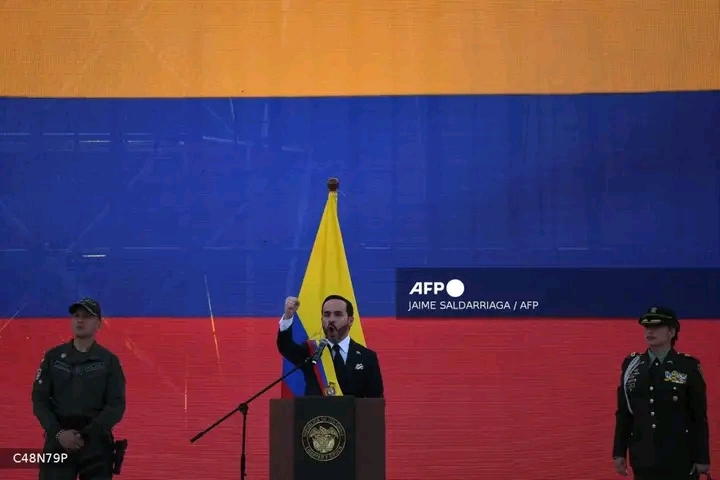
Colombia’s New President Ends Peace Talks, Unveils Hardline War on Narco Terrorism With U.S. Backing.
BOGOTÁ, Colombia Colombia’s newly inaugurated President, Abelardo de la Espriella, has announced a decisive break with his predecessor Gustavo Petro’s approach to armed groups, declaring an end to further peace negotiations and promising an aggressive security campaign against drug-trafficking organisations and insurgent groups.
De la Espriella, a right wing political newcomer who assumed office on August 7, 2026, has made the dismantling of Colombia’s powerful criminal and armed groups a central priority of his administration. His government says the new strategy is intended to restore security, strengthen state authority and confront organisations that have expanded their influence through narcotics trafficking and territorial control.
The president’s position represents a significant shift from Petro’s “Total Peace” strategy, under which the government sought negotiations with several armed and criminal organisations. De la Espriella has argued that the dialogue process failed to deliver lasting security and instead gave some armed groups an opportunity to strengthen their operations.
Reuters reported that the new president has ruled out further peace talks and pledged a tougher campaign against armed groups, including support for aerial herbicides to destroy coca crops.
From Negotiations to Military Pressure
De la Espriella campaigned on an “iron fist” security platform, promising to use the country’s security forces more aggressively against organisations involved in cocaine production, trafficking and armed violence.
His administration has indicated that groups refusing to surrender could face intensified military operations. Among the organisations expected to come under pressure are the Gulf Clan and the National Liberation Army (ELN), as well as dissident factions that emerged from Colombia’s former FARC guerrilla movement.
The incoming president had previously announced plans to dismantle the presidential peace office, arguing that Colombia should no longer pursue what he described as ineffective peace processes with criminal organisations. AFP reported that he also planned to terminate or restructure institutions associated with the previous administration’s peace strategy.
The policy marks a sharp departure from Petro, who attempted to negotiate with multiple armed groups as part of efforts to reduce decades of violence. Those negotiations faced setbacks, with renewed fighting and territorial disputes undermining the government’s peace initiative.
Closer Security Alignment With Washington
The shift in Colombia’s security policy is also expected to deepen cooperation with the United States, particularly on counter-narcotics operations and intelligence sharing.
The Guardian reported that Washington has pledged $1 billion in security assistance to Colombia as the new government prepares to intensify its campaign against drug-trafficking organisations.
The new administration has also signalled its willingness to participate in broader U.S. backed regional security initiatives targeting transnational drug networks.
The renewed partnership comes after years of tension between Washington and the Petro administration over drug policy. While Colombia and the United States continued to cooperate against narcotics trafficking under Petro, the two governments differed substantially over strategies for coca eradication, negotiations with armed groups and the use of military force.
De la Espriella’s approach is expected to bring Colombian and U.S. security policies closer together.
A Major Test for Colombia’s Security Strategy
The president’s tougher approach comes as Colombia continues to face complex security challenges involving guerrilla organisations, criminal networks, illegal mining, cocaine trafficking and territorial disputes in remote areas.
Supporters of the policy argue that stronger military pressure is necessary to prevent armed organisations from exploiting negotiations to expand their territorial and economic influence. Critics, however, are likely to question whether a predominantly military response can address the underlying causes of Colombia’s long running conflict, including rural poverty, weak state presence and the profitability of the illegal drug trade.
De la Espriella has also promised broader institutional and economic reforms, including reducing the size of government and encouraging investment in the energy sector. His administration will nevertheless face political challenges as it attempts to implement its agenda in a country where security policy remains deeply contested.
A New Chapter in Colombia-U.S. Relations
The inauguration of De la Espriella signals a broader political and policy realignment in Colombia, moving the country away from Petro’s left wing administration and toward a more conservative security and economic agenda.
His decision to abandon negotiations with armed groups, intensify counter narcotics operations and strengthen cooperation with Washington could make Colombia a key partner in the United States’ renewed regional campaign against drug trafficking.
At the same time, the success of the strategy will depend on whether intensified military pressure can translate into lasting improvements in public security without worsening displacement, civilian casualties or human rights concerns.
For Colombia, the coming months will therefore provide an important test of whether a hardline security strategy can dismantle the country’s entrenched narco-trafficking networks while delivering the stability and public confidence promised by the new administration.