


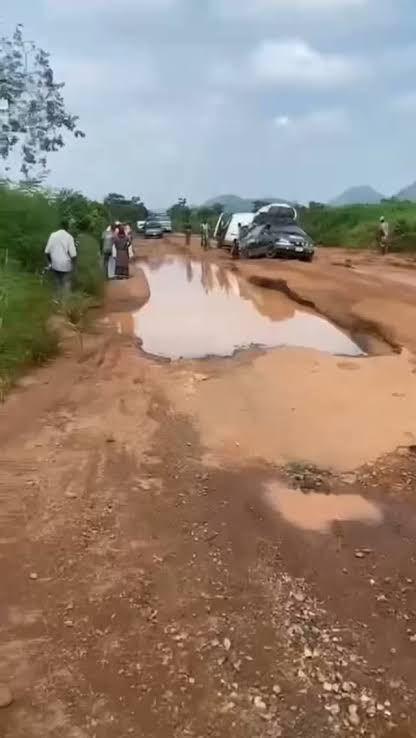
Erosion Ravaged Road Cripples Businesses in Kwara Community as Traders Seek Urgent Government Intervention.
Residents and traders in Ero Omo Kilanko Biada community, located in Ilorin South Local Government Area of Kwara State, have appealed to the state government to urgently rehabilitate their deteriorating access road, warning that its deplorable condition is disrupting commercial activities, transportation and everyday life.
The community’s concerns follow the development of a deep erosion gully that has rendered sections of the road nearly impassable, making it increasingly difficult for motorists, commercial motorcyclists and pedestrians to access homes and businesses.
According to news reports, the worsening situation has forced motorists to park their vehicles far from their homes, while commercial motorcyclists now drop passengers before reaching the badly affected sections. Traders have also been compelled to transport goods manually over considerable distances because delivery vehicles can no longer reach their shops.
The impact on local businesses has been particularly severe. Business owners say the road’s condition has disrupted the distribution of essential commodities, increased the difficulty of transporting merchandise and reduced their ability to serve customers effectively.
A businessman, Temitope Olayemi, described the situation as a major setback for commercial activities, explaining that vehicles and motorcycles can no longer move conveniently through the community.
Similarly, a businesswoman, Tosin Araoye, disclosed that suppliers of sachet water can no longer deliver directly to her shop. Instead, distributors reportedly leave their goods along the expressway, forcing traders to carry them manually to their business locations.
Commercial motorcyclists have also expressed concerns over the economic and safety implications of the damaged road. Operators reportedly earn less because they cannot complete their usual journeys, while residents carrying goods and other belongings face additional difficulties.
Beyond the disruption of transportation and business activities, residents have warned that the expanding erosion gully poses a threat to nearby residential buildings. They fear that further rainfall could worsen the damage, potentially cutting off access to more homes and businesses.
The Secretary of the Ero Omo Kilanko Biada Community Association, Saka Abdulkadir, has appealed to the Kwara State Government, under Governor AbdulRahman AbdulRazaq, to rehabilitate the road and provide adequate drainage infrastructure to prevent further erosion.
The community’s appeal comes amid previous government assurances concerning the rehabilitation of Kilanko Road and other deteriorating road corridors in Ilorin.
The state’s former Commissioner for Works, Qowiyu Olododo, had earlier disclosed that engineers from the Ministry of Works visited the affected areas to assess the road conditions and consider appropriate reconstruction and drainage designs.
However, residents insist that the situation in Ero Omo Kilanko Biada requires urgent attention, stressing that improvements to neighbouring road networks would not adequately address their difficulties unless the erosion-affected access road is also rehabilitated.
The situation highlights the broader relationship between rural and urban infrastructure, local commerce and community development. Poor road networks can increase transportation costs, restrict access to essential goods and services, discourage business activities and undermine the economic potential of affected communities.
For traders and residents of Ero Omo Kilanko Biada, the immediate priority is a lasting solution that combines proper road reconstruction with effective drainage systems to prevent recurring erosion.
As the community continues to appeal for intervention, residents are urging the Kwara State Government to translate previous infrastructure commitments into practical action before further deterioration leaves the area increasingly inaccessible.