

The Federal Government has partnered with the United Nations Development Programme, UNDP, to begin a coordinated drive aimed at improving Nigeria’s sovereign credit rating, reducing borrowing costs, and making the country more attractive to investors.
The initiative was unveiled on Wednesday at a High-Level Debriefing Meeting on the Credit Ratings Needs Assessment Mission for Nigeria held in Abuja.
Speaking at the meeting, the Minister of Finance and Coordinating Minister of the Economy, Mr. Taiwo Oyedele, said African countries have for years paid far more to borrow than their economic fundamentals justify. He described it as the “African Premium.”
Represented by the Permanent Secretary, Special Duties, Mr. Mohammed Sanusi, Oyedele said perception gaps cost the continent an estimated $74.5 billion annually in extra borrowing costs.
“For too long, African countries have borne what is often described as the African Premium — a perception gap estimated to cost the continent more than $74.5 billion annually in additional borrowing costs,” he said.
He noted that the government’s focus is not on blaming the global financial system, but on strengthening Nigeria’s own institutions, improving engagement with rating agencies, and ensuring that Nigeria’s sovereign ratings reflect the country’s economic reality
Oyedele said recent actions by international rating agencies suggest that ongoing reforms are being noticed. He pointed to upgrades and positive outlooks from Moody’s, Fitch Ratings, and S&P Global Ratings, as well as a favorable IMF Article IV Consultation, as evidence of growing confidence in Nigeria’s economy.
However, he stressed that credit ratings are not determined by economic performance alone.
“Our objective is not merely to secure higher ratings but to ensure that Nigeria’s credit profile accurately reflects the progress of our reforms and the vast opportunities within our economy,” he said.
According to him, key factors include the quality and timeliness of data, institutional coordination, policy credibility, clear communication, and consistent engagement with international rating agencies.
UNDP Chief Economist for Africa, Mr. Raymond Gilpin, said the need for better ratings has become more urgent because traditional development assistance is shrinking.
“Traditional development assistance is declining, and many countries now rely more on the capital market to finance development,” Gilpin said. “At the same time, financing the Sustainable Development Goals and the African Union’s Agenda 2063 has become increasingly difficult.”
He explained that many African countries have moved into middle-income status, which reduces access to concessional loans even as their financing needs grow. That leaves governments with tough choices between paying debt and investing in infrastructure, poverty reduction, and technology.
Gilpin described sovereign credit ratings as one of the most important tools for determining the cost of capital.
“Credit ratings determine how global investors assess the risks of investing in developing countries. Improving those ratings is therefore essential to attracting affordable capital and unlocking long-term development financing,” he said.
To help countries address these challenges, UNDP launched the Africa Credit Ratings Initiative in partnership with the African Development Bank, UNECA, the Africa Centre for Economic Transformation, and the African Peer Review Mechanism.
The initiative is designed to help governments improve data systems, build institutional capacity, and engage more effectively with rating agencies.
As part of the program, UNDP recently sponsored 22 senior officials from 11 African countries to study how the Philippines moved from non-investment grade to investment grade. Gilpin said Nigeria can learn from that experience.
One major gap he identified is data. Many African countries, he said, struggle to provide credible, timely, and transparent economic data, which leaves room for subjective assessments by rating agencies.
Despite these challenges, Gilpin expressed optimism about Nigeria. He said ongoing reforms and recent rating improvements put the country on a path toward investment-grade status, which would significantly boost investor confidence and lower the cost of borrowing.
Also at the meeting, the Canadian High Commissioner to Nigeria, Mr. Pasquale Salvaggio, reaffirmed Canada’s commitment to deepening economic relations with Nigeria.
He disclosed that Canada’s non-oil trade with Nigeria has grown by 50 percent, making Nigeria Canada’s second-largest trading partner in Africa.
Salvaggio added that Canada will also work with the Nigerian diaspora to increase investment flows into key sectors of the economy.
The debriefing focused on practical steps Nigeria can take to improve its engagement with rating agencies and strengthen institutions responsible for economic data and policy communication.
Officials said the goal is not just a better rating on paper, but a rating that accurately reflects the progress of reforms and the long-term growth potential of the economy.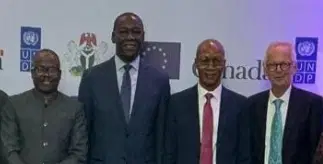

For the Federal Government, a higher sovereign rating means cheaper loans for infrastructure, lower interest payments, and more room to invest in development.
With global financing becoming more competitive and development aid declining, Nigeria’s ability to access affordable capital will increasingly depend on how well it tells its economic story — with data, transparency, and consistency.
The partnership with UNDP is expected to provide technical support in those areas over the next 12 to 18 months, with regular assessments to track progress.
As Oyedele put it, the aim is simple: ensure that Nigeria’s credit rating matches its potential