

Abuja – The Federal Government on June mounted a strong defence of President Bola Tinubu’s reform agenda, saying Nigeria is steadily emerging from economic fragility and laying groundwork for long-term prosperity despite the pain of current adjustments.
At a Democracy Day press conference in Abuja marking 27 years of uninterrupted democracy and the third anniversary of the Renewed Hope Agenda, top officials said available data point to recovery, growth, and institutional strengthening.
Minister of Information and National Orientation, Mohammed Idris, described Democracy Day as a moment for reflection and accountability, paying tribute to late M.K.O. Abiola and pro-democracy activists including President Tinubu.
Secretary to the Government of the Federation, Senator George Akume, who represented Tinubu, acknowledged economic hardship but insisted policies are yielding results.
“Government will never claim that every challenge has been solved. Inflation has been painful, insecurity still threatens lives and livelihoods, and the effects of reform do not land evenly or immediately,” Akume said. “However, evidence shows that Nigeria is moving in the right direction, from fragility toward firmer footing, from stop-gap actions toward systemic reform.”
Citing National Bureau of Statistics data, Akume said GDP growth stood at 4.07% in Q4 2025 and 3.89% in Q1 2026, signaling growing investor confidence and improved market activity. He noted that Tinubu signed four major tax reform laws in June 2025 to simplify compliance and boost domestic revenue.
The Renewed Hope Conditional Cash Transfer reached over 3 million vulnerable households by August 2025, out of a target of 15 million. Nearly 1 million Nigerians benefited from the Presidential Conditional Grant and CreditCorp schemes.
Akume said anti-graft agencies continue to recover stolen assets and prosecute offenders, with the EFCC contributing over N50 billion in recovered funds to the student loan programme. Nigeria was removed from the Financial Action Task Force grey list in October 2025 following improvements in anti-money laundering and counter-terrorism financing.
On security, he said the government is making progress against terrorism and banditry through increased investment in security agencies and better operational capacity, though insecurity has not been fully eradicated. “The good news is that we are succeeding,” he stated.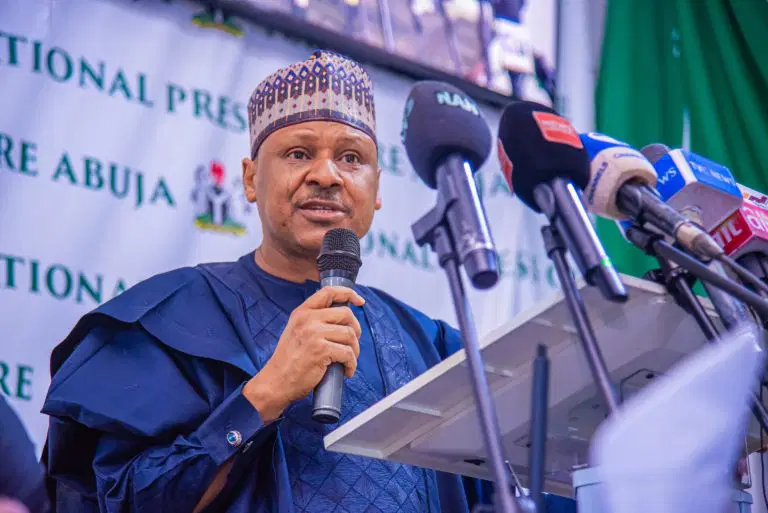

The Federal Executive Council approved a National Values Charter to promote discipline, citizenship, and tolerance. Akume also reaffirmed support for the Nigeria Inter-Religious Council to strengthen national stability.
Looking to 2027, Akume said the administration’s focus remains on completing reforms begun in 2023 and scaling what is working. “Our responsibility is to finish what we commenced in 2023. Under President Tinubu, more dividends of democracy will be delivered,” he said.
“This government is prepared to be judged by evidence,” he added as ministers presented sector-by-sector performance reports.