


France Rocked by Violent Protests as Rising Living Costs Fuel Nationwide Unrest.
France is facing one of its most serious waves of civil unrest in years after nationwide demonstrations over rising living costs, deteriorating public services and education challenges escalated into violent clashes in several cities.
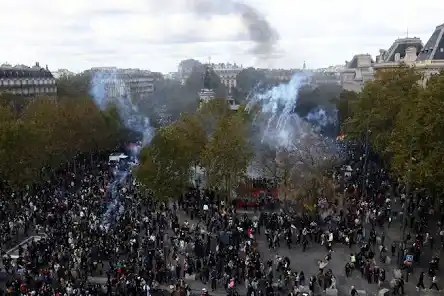
The protests, which took place on Saturday, October 17, 2026, attracted hundreds of thousands of demonstrators across the country. While many participated in peaceful marches, some groups clashed with police, looted shops and damaged public buildings.
According to Reuters, violence spread across several cities, including Paris, Marseille, Lyon and Limoges. In Limoges, the city hall was set ablaze, while protesters reportedly broke into municipal buildings in Marseille and torched a tourist office in Lyon. Police deployed tear gas as officers confronted demonstrators.
Rising Living Costs Drive Public Anger
The demonstrations reflect growing frustration among sections of the French population over the cost of living, inequality and concerns about the quality of public services.
What began as a movement linked to complaints about school conditions and teacher shortages in disadvantaged areas has expanded into a broader protest against economic pressures and government spending priorities.
Students, trade union members and supporters of the Yellow Vest movement joined demonstrations in cities across France. Participants expressed concerns about purchasing power, inadequate school facilities, staffing shortages and the difficulties faced by lower-income households.
The protests have also revived memories of France’s 2018/2019 Yellow Vest movement, which emerged over fuel prices and expanded into a wider challenge to economic inequality and government policies.
Clashes With Police Lead to Arrests and Injuries
Authorities faced a difficult security situation as peaceful demonstrations were disrupted by violence in several locations.
Reuters reported that demonstrators attacked police vehicles and officers, while shops and public buildings were damaged. Police responded with tear gas and other crowd control measures.
Reports published on October 18 gave differing figures for arrests, injuries and attendance, reflecting the evolving situation and differences between official and organisers’ estimates.
French President Emmanuel Macron condemned the violence, while Prime Minister Sébastien Lecornu warned that the government would not allow violent groups to dictate the country’s political direction.
Authorities have also faced scrutiny over their handling of demonstrations, including concerns about injuries caused by crowd control weapons.
Political Tensions Intensify Ahead of Elections
The unrest comes at a sensitive time for French politics, with the country approaching its 2027 presidential election.
The demonstrations have intensified disagreements between the government and opposition groups over economic policy, public spending and responsibility for the country’s social challenges.
Government officials have blamed radical groups and individuals involved in criminal activity for escalating the violence. Opposition figures, meanwhile, have continued to raise concerns about living costs, inequality and the condition of public services.
However, the demonstrations involve a range of participants and grievances, making it important to distinguish between peaceful protesters and those responsible for violence or property destruction.
The growing unrest presents a challenge for French political leaders as they attempt to address public dissatisfaction while maintaining security and protecting the right to peaceful protest.
Economic Pressure and Public Services at the Centre of the Crisis
France’s latest unrest highlights the difficulties governments face when economic pressures combine with concerns about public services and social inequality.
For many demonstrators, the issues extend beyond individual price increases to broader questions about wages, education, public investment and the distribution of economic opportunities.
The demonstrations also underline the importance of maintaining channels for dialogue between governments, students, workers and civil society groups.
As authorities assess the damage and investigate violent incidents, the government’s response could influence whether tensions ease or further demonstrations emerge.
What Happens Next?
The immediate priorities for French authorities include restoring order, investigating attacks on public property, determining responsibility for violent incidents and ensuring that those affected receive appropriate assistance.
At the same time, addressing the underlying grievances may require sustained engagement with students, trade unions, workers and communities experiencing economic hardship.
France’s challenge is to protect public safety without undermining the right to peaceful demonstration.
The coming days will be important in determining whether the unrest subsides or develops into a more prolonged political and social crisis.