

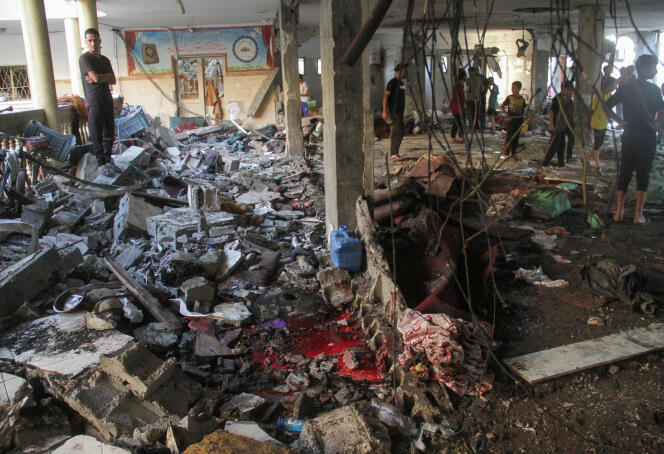
On August 12, 2024, a devastating airstrike by Israeli forces targeted the Al-Tabieen religious school and mosque in Gaza City, resulting in the tragic deaths of at least 93 displaced civilians, including 17 women and children. This incident has sparked widespread condemnation from political leaders around the world, calling for an immediate ceasefire and renewed scrutiny of Israel’s military actions in the region.
The airstrike was described by Gaza’s civil defense agency as one of the deadliest in the ongoing conflict, which has seen numerous attacks on civilian infrastructures, particularly schools. The United Nations human rights office has reported at least 21 attacks on educational facilities since July 4, 2024, contributing to the rising civilian death toll amid the ongoing hostilities.
In response to the strike, the Israeli military refuted the high civilian death toll reported by Palestinian authorities, asserting that the school was utilized as a military facility by Hamas and Islamic Jihad militants. The military claimed its operation was conducted using “precision munitions,” aimed specifically at eliminating what it described as an active threat. It stated that at least 19 militants were killed in the airstrike, framing the action as a necessary measure in the fight against terrorism.
The ramifications of the strike have drawn significant attention from international leaders. The White House expressed deep concern over the civilian casualties and emphasized the urgent need for a ceasefire and a resolution to the hostage situation. Vice President Kamala Harris addressed the issue during a press conference in Phoenix, Arizona, stating, “Once again, far too many civilians have been killed. Israel has a right to pursue terrorists, but they also have a responsibility to avoid civilian casualties.” She underscored the critical need for a hostage deal and reiterated the administration’s commitment to securing the release of those held captive.

Responses from other world leaders were equally stark. British Foreign Minister David Lammy expressed his horror at the attack, calling for an immediate cessation of hostilities to protect civilians, free all hostages, and ensure the unimpeded flow of humanitarian aid. France’s foreign ministry echoed these sentiments, highlighting the repeated targeting of educational institutions and stressing that Israel must adhere to international humanitarian law.
The Spanish government also called for adherence to provisional measures laid out by the International Court of Justice, emphasizing the need to protect civilian populations. Josep Borrell, the European Union’s foreign policy chief, voiced his horror at the strike, noting that at least ten schools had been targeted in recent weeks and condemning the violence as unjustifiable.
Reactions within the Arab world were swift and critical. Qatar, acting as a mediator in the ongoing conflict, demanded an urgent investigation into the Israeli forces’ actions against schools and shelters. Egypt’s foreign ministry condemned the attack as a blatant violation of international law, expressing concern over Israel’s apparent disregard for the humanitarian crisis unfolding in Gaza. Jordan’s foreign ministry suggested that the timing of the strike appeared to undermine mediation efforts aimed at achieving peace.
Iran’s foreign ministry spokesperson denounced the attack as indicative of Israel’s disregard for international laws and human rights, calling for global solidarity in support of the Palestinian people. The Lebanese militant group Hezbollah described the strike as a “horrific massacre,” urging international outrage and support for Palestinians.
Moscow also expressed its shock, with a foreign ministry spokeswoman reiterating the importance of adhering to international humanitarian law and calling on Israel to refrain from attacking civilian targets. Turkey’s foreign ministry characterized the strike as a “new crime against humanity,” accusing Israeli Prime Minister Benjamin Netanyahu of sabotaging ceasefire negotiations.
This tragic incident in Gaza highlights the ongoing humanitarian crisis and the complex dynamics of the conflict, which has escalated since the outbreak of hostilities following Hamas’s surprise attack on Israel in . As the situation continues to deteriorate, the international community finds itself increasingly pressed to respond to the humanitarian needs of civilians caught in the crossfire and to advocate for a resolution to the cycle of violence that has claimed countless lives. The calls for ceasefire and adherence to international law resonate louder than ever as the world grapples with the consequences of the ongoing conflict in Gaza.