


The Governor of Edo State, Senator Monday Okpebholo, has received the report of the 2025 Hajj exercise from the Edo State Muslim Pilgrims Welfare Board, calling for early and more structured planning ahead of future pilgrimages.
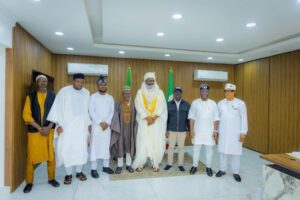

The report was presented by the Amirul Hajj, HRH Mallam Ali D. Suleyman, the Oghieaga of Ivbie, who led members of the board on a visit to the Government House.
Speaking during the meeting, Governor Okpebholo described Hajj as a long-standing religious obligation that requires deliberate and timely preparation. He expressed concern over the late submission of requests to the government, noting that it hindered effective intervention for the 2026 exercise.
“When problems are brought early, they can be solved early. But when something is happening tomorrow and you bring the request today, it becomes difficult to address,” the governor said.
He urged stakeholders to commence preparations for future pilgrimages at least nine months in advance, with particular focus on the health and readiness of intending pilgrims.
The governor reaffirmed his administration’s commitment to supporting Muslim faithful in the state and promoting peaceful coexistence.
“I assure you we will continue to support the Muslim community in Edo State. We will continue to live together peacefully,” he added.
Governor Okpebholo also disclosed plans to explore the possibility of securing approval for Edo State to serve as a departure point for pilgrims in the South-South region, noting that such a move could stimulate economic activities in the state.
He commended the Amirul Hajj and members of the board for what he described as a successful 2025 Hajj exercise.
Earlier, Mallam Ali D. Suleyman lauded the governor’s support, describing the 2025 outing as one of the most successful in the state’s history. He said government intervention improved the welfare of pilgrims, including better accommodation close to the Ka’aba, provision of Nigerian meals, and enhanced medical services.
According to him, the quality of Edo State’s arrangements attracted attention from officials of the National Hajj Commission of Nigeria (NAHCON) and pilgrims from other states, some of whom benefitted from the facilities.
However, he noted that preparations for the 2026 Hajj have been affected by a strict payment deadline imposed by Saudi authorities, which significantly reduced the number of participants.
He disclosed that over 351 intending pilgrims were unable to meet the deadline, leaving only 93 eligible to participate in the 2026 exercise.
The Amirul Hajj also appreciated the governor for sponsoring 50 pilgrims, though noting that not all could be accommodated due to the constraints.
He highlighted operational challenges facing the board, including inadequate power supply, poor internet connectivity, security concerns, and lack of official vehicles for logistics both within Nigeria and in Saudi Arabia.
Despite the challenges, he expressed optimism that with improved planning and sustained government support, Edo State could emerge as a major Hajj departure hub for the South-South and South-East regions.
Other dignitaries present at the meeting included the Secretary to the State Government, Umar Musa Ikhilor; Chairman of the Edo State Muslim Pilgrims Welfare Board, Mallam Musa Muhammad Uduimoh; Executive Secretary of the Board, Alhaji Eranga Abdulkabir Muhammadkabir; and Acting Chairman of Edo State Musaabaqah, Barr. Hamza Umar.