


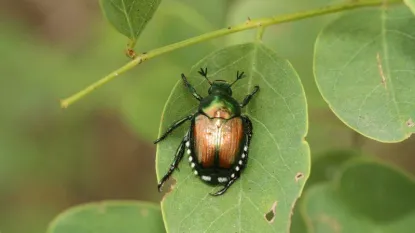
Japanese Beetle Threat Expands Beyond Native Range, Raising Global Agricultural Concerns.
The Japanese beetle, a small metallic green insect native to Japan, has become one of the world’s most closely monitored invasive pests due to its ability to damage hundreds of plant species and disrupt agricultural production. As its presence expands into new regions, scientists and agricultural authorities are intensifying surveillance and control efforts to prevent widespread ecological and economic losses.
Known scientifically as Popillia japonica, the Japanese beetle feeds on the leaves, flowers, fruits, and roots of more than 300 plant species. Crops such as grapes, maize, soybeans, apples, berries, roses, and ornamental plants are among its preferred hosts, making the insect a significant concern for farmers, horticulturalists, and environmental agencies.
Although the beetle is native to Japan where natural predators help keep its population under control it has established invasive populations in several countries, including the United States, Canada, and parts of Europe. In recent years, detections in countries such as Italy and Switzerland have prompted coordinated monitoring and eradication campaigns aimed at preventing further spread across the European continent.
Experts say international trade, movement of soil, plants, and cargo have contributed significantly to the insect’s expansion beyond its natural habitat. Once established, the beetle can reproduce rapidly, with larvae feeding on grass roots while adults skeletonize plant leaves, reducing crop yields and weakening vegetation.
Agricultural researchers warn that climate change may also create more favourable conditions for the beetle to survive in regions that were previously unsuitable. Rising temperatures and changing weather patterns could increase the risk of establishment in new territories, placing additional pressure on food production systems and biodiversity.
To combat the threat, plant health authorities have adopted integrated pest management strategies, including pheromone traps, biological control methods, quarantine measures, and public awareness campaigns. Farmers are also encouraged to report suspected sightings promptly to enable early detection and rapid response.
The challenge posed by the Japanese beetle highlights the growing importance of international cooperation in managing invasive species. Experts stress that effective biosecurity policies, scientific research, and cross border collaboration remain essential to protecting agriculture, ecosystems, and global food security from emerging biological threats.