


Lagos’ Forgotten Children: How Poverty, Displacement and Poor Living Conditions Threaten Futures in Ijora-Badia, Ago-Egun.
LAGOS, Nigeria Behind Lagos’ image as Nigeria’s commercial powerhouse, children in some of the city’s most vulnerable communities continue to grow up amid conditions that threaten their health, education and long-term prospects.
In communities including Ijora-Badia and Ago-Egun, families face a combination of poverty, inadequate housing, limited access to clean water and sanitation, healthcare challenges and food insecurity. For children, the consequences can extend far beyond immediate hardship, affecting their ability to remain healthy, attend school consistently and build a secure future.
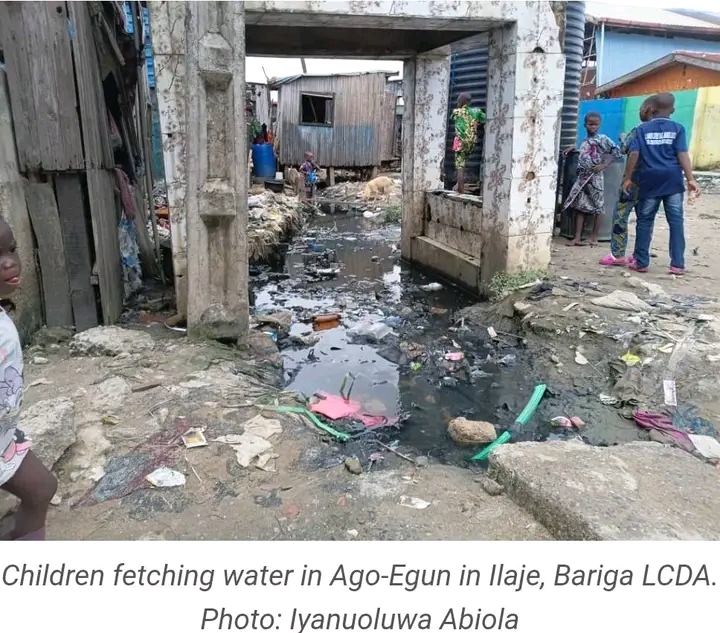
A 2022 report by PUNCH documented the difficult circumstances of children in Ago-Egun, Bariga, describing families struggling with access to basic education, healthcare, shelter, water, sanitation and hygiene. The report found that some children depended on charity for food and other basic needs, while some attended school without shoes.
The situation in Ijora-Badia has similarly attracted sustained concern from journalists, researchers and civil society organisations.
A childhood shaped by deprivation
For children growing up in informal settlements, poverty is rarely limited to household income. It can determine whether a child has nutritious food, safe housing, clean water, medical attention and a stable environment in which to learn.
Research published on Ijora-Badia has documented longstanding deficiencies in water supply, sanitation, drainage and waste management. One study found that a significant proportion of residents relied on water vendors, while inadequate sanitation and drainage exposed communities to serious environmental and public health risks.
More recent research published in 2026 also identified Ijora-Badia among Lagos coastal settlements experiencing inadequate water and sanitation infrastructure, deteriorating housing conditions, flooding and other environmental pressures.
These challenges have particular implications for children, who are more vulnerable to the effects of unsafe water, poor sanitation, inadequate nutrition and preventable illness.
When displacement becomes a generational burden
The difficulties facing some Ijora-Badia residents are also rooted in a history of displacement.
In 2013, large scale demolitions in Badia displaced thousands of residents. Years later, The Guardian Nigeria reported that many affected residents were still waiting for promised housing or compensation, highlighting the long term consequences of forced displacement on already vulnerable households.
The history is significant because displacement does not end when bulldozers leave. Families that lose homes, livelihoods and community networks can face years of instability. Children may be forced to change schools, abandon education temporarily or grow up in increasingly precarious living conditions.
Recent flooding has added another layer of vulnerability. In April 2026, PUNCH reported that flooding in Ijora-Badia submerged parts of a local primary school after a canal was reportedly blocked, preventing some pupils from attending classes.
Education as a pathway out
Despite these challenges, community based initiatives have demonstrated that children in underserved Lagos communities are not defined by their circumstances.
The Guardian Nigeria reported in July 2026 on efforts by the Slum Art Foundation and Mutual Benefits Assurance Group to support children in Ijora-Badia through education, creative development and school-fee assistance. The foundation operates a free school constructed largely from recycled PET bottles and has used art and education to expand opportunities for children in the community.
Earlier, The Guardian also reported on an initiative involving Ijora-Badia children in a global campaign against modern slavery, highlighting concerns around child labour, forced marriage and domestic servitude while promoting education and creative development.
These initiatives illustrate an important point: interventions directed at children can produce meaningful change, but charity alone cannot substitute for functioning public infrastructure and effective social protection.
Beyond charity: the need for structural solutions
The challenges facing Ijora-Badia and Ago-Egun require more than occasional donations or short-term humanitarian interventions.
Sustainable improvement requires investment in affordable and secure housing, potable water, sanitation, drainage, primary healthcare, nutrition programmes and accessible schools. It also requires policies that protect vulnerable families from displacement without adequate resettlement arrangements.
Civil society organisations, businesses and community groups have demonstrated that targeted interventions can help bridge some gaps. But responsibility for guaranteeing children’s basic rights ultimately extends beyond individual organisations.
For Lagos, one of Africa’s largest and fastest-growing urban centres, the treatment of children in its informal settlements is also a measure of the city’s development priorities.
The children of Ijora-Badia and Ago-Egun do not lack potential. What remains in short supply is the infrastructure, protection and opportunity required to convert that potential into lasting progress.
Their circumstances should therefore not be treated simply as a story of poverty, but as a test of whether Lagos can build an urban future in which economic growth reaches the communities living furthest from its benefits.