

Israeli Prime Minister Benjamin Netanyahu issued a sharp warning to Tehran on Tuesday, saying Israel will respond with far greater force if Iran launches another attack against his country.
Speaking at a conference in Dimona, a southern town that hosts Israel’s official nuclear research facility and is widely believed to house its undeclared nuclear arsenal, Netanyahu directed his message straight at Iran’s leadership.
“I will say it to the leaders of Iran: Do not count on things remaining quiet if you attack us,” he said. “The days are over when someone strikes us and we don’t hit back with a decisive blow.”
Netanyahu made clear that any future Israeli response would go beyond what was seen earlier this year during joint strikes with the United States.
“Do not count on a rerun,” he said in a video released by his office, referring to the previous round of attacks. “Because it will not be a rerun, and that was already powerful enough. This will be a different event, much more powerful.”
The warning comes at a moment of heightened escalation in the region. The United States carried out new strikes on Tuesday, including on the Iranian port city of Bushehr, home to Iran’s only civilian nuclear power plant. US President Donald Trump also vowed to reimpose a naval blockade on Iranian ports.
Those American strikes followed three days of US military action against Iranian targets. In retaliation, Iran has fired missiles at US allies in the region, further raising fears of a wider conflict.
Netanyahu’s remarks in Dimona linked Israel’s security directly to the current US-Iran confrontation. By speaking from a site associated with Israel’s nuclear program, he signaled both resolve and deterrence, aiming to make clear that Israel will not absorb an attack without a decisive military answer.
Dimona has long been central to Israel’s strategic posture. While the government describes the facility there as a center for nuclear research, foreign analysts widely believe it is the core of Israel’s undeclared nuclear weapons program. Netanyahu’s choice to deliver the warning from that location added weight to his message.
The prime minister did not detail what form a “much more powerful” strike would take. However, his reference to moving beyond a “rerun” of earlier operations suggests Israel is prepared to expand both the scale and targets of any retaliation, potentially beyond the limited, coordinated strikes carried out with Washington earlier this year.
The timing is critical. With US forces now directly engaged and Trump promising to choke Iran’s maritime trade, the risk of miscalculation has grown. Iran’s missile launches against US-aligned states show it is willing to hit back, and Netanyahu’s statement indicates Israel intends to act independently and more forcefully if it is drawn in.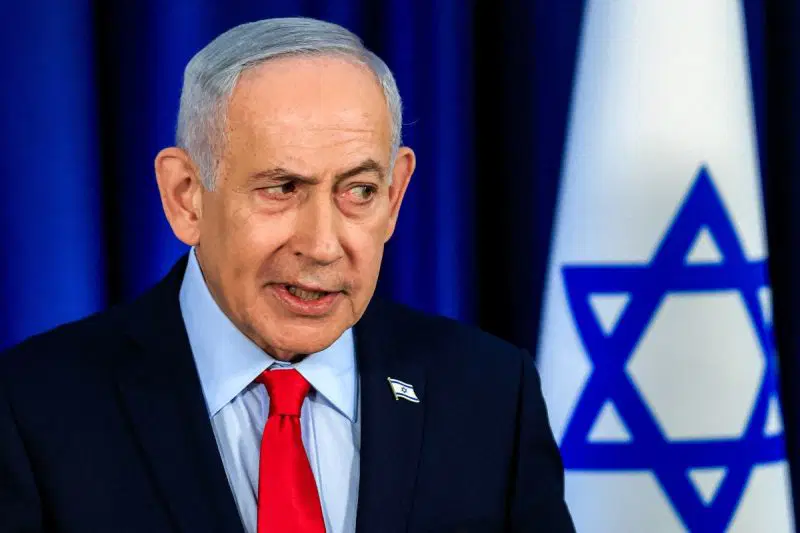

Regional leaders have watched the exchange with alarm. Any direct Israeli-Iranian clash, especially one described as more powerful than previous exchanges, could destabilize energy routes, draw in other US allies, and escalate into a broader war.
For now, Netanyahu’s message is one of deterrence. He wants Tehran to understand that restraint from Israel after past attacks should not be taken as weakness, and that the rules have changed.
“If you attack us,” he warned, “do not expect quiet. Expect a decisive blow, and expect it to be far stronger than before.”
As US strikes continue and diplomatic channels remain strained, the coming days will test whether that warning is enough to prevent another round of escalation, or whether the region is heading toward a larger confrontation.