


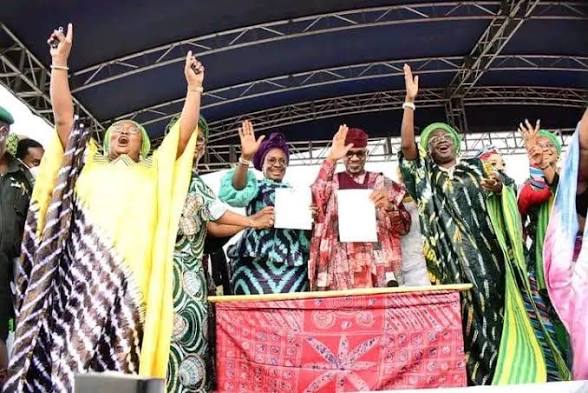
Ogun Deputy Governor, First Lady Push for Greater Women’s Representation in Political Appointments and Leadership.
Ogun State Deputy Governor, Engr. Noimot Salako Oyedele, and the First Lady, Mrs Bamidele Abiodun, have called for increased participation of women in political appointments and leadership positions, stressing the importance of gender inclusion in governance and national development.
The call reflects growing concerns over the persistent underrepresentation of women in Nigeria’s political institutions and decision making processes.
Speaking during activities marking the 2026 International Women’s Day celebration in Ijebu Ode, Ogun State, both government officials joined other female political leaders and stakeholders in advocating stronger support for women’s participation in governance.
Salako Oyedele expressed optimism that more women would occupy strategic political positions in Nigeria, emphasizing that women have the experience, competence and leadership capacity required to contribute meaningfully to public administration.
The First Lady, Bamidele Abiodun, encouraged women to take advantage of government initiatives and empowerment programmes while urging them to translate their numerical strength into meaningful political influence.
She also highlighted the importance of political participation, particularly through voter registration and the responsible use of Permanent Voter Cards (PVCs), noting that women’s collective involvement could influence the direction of governance.
The event, organised by the Ogun State Ministry of Women Affairs and Social Development, attracted thousands of women from different parts of the state, including political office holders, professionals and community stakeholders.
Former Ekiti State Deputy Governor, Senator Abiodun Olujimi, also emphasised the need for stronger support systems, mentorship and collaboration to address the structural barriers preventing women from attaining leadership positions.
She maintained that International Women’s Day should go beyond celebrations to encourage meaningful conversations about reforms capable of improving opportunities for Nigerian women and girls.
The Commissioner for Women Affairs and Social Development, Hon. Motunrayo Adijat Adeleye, equally stressed the importance of investing in women and supporting their economic and political advancement.
As part of the empowerment activities, 50 women reportedly received grants of ₦200,000 each, while another 500 women received ₦50,000 each to support their economic activities.
Nigeria’s Wider Gender Representation Challenge
The renewed call for women’s inclusion comes amid longstanding concerns about the limited number of women occupying elective and appointive positions across Nigeria.
Although women constitute a substantial proportion of the country’s population and contribute significantly to its economy, political participation remains disproportionately low.
The challenge extends beyond appointments to political party structures, candidate selection processes, campaign financing and access to opportunities to contest elective offices.
In March 2026, Salako Oyedele and other female deputy governors elected on the platform of the All Progressives Congress (APC) intensified the campaign for gender inclusion ahead of the 2027 general elections.
Under the Female Deputy Governors Forum, they urged the APC leadership to adopt a framework guaranteeing at least 35 per cent representation for women in elective and appointive positions.
The forum also advocated deliberate support for the emergence of at least one female governor in each of Nigeria’s six geopolitical zones.
The APC National Chairman, Professor Nentawe Yilwatda, reportedly acknowledged the imbalance and pledged that the party’s National Working Committee would work towards improving women’s representation.
For Ogun State and Nigeria more broadly, the growing advocacy presents an opportunity to move beyond symbolic commitments towards measurable political inclusion.
However, achieving meaningful progress will require deliberate policies, transparent appointment processes, stronger political party commitments and sustained support for women seeking leadership positions.
As the country approaches another election cycle, the effectiveness of these commitments will ultimately be measured not by public assurances but by the number of women who gain access to influential positions and participate meaningfully in shaping public policy.