


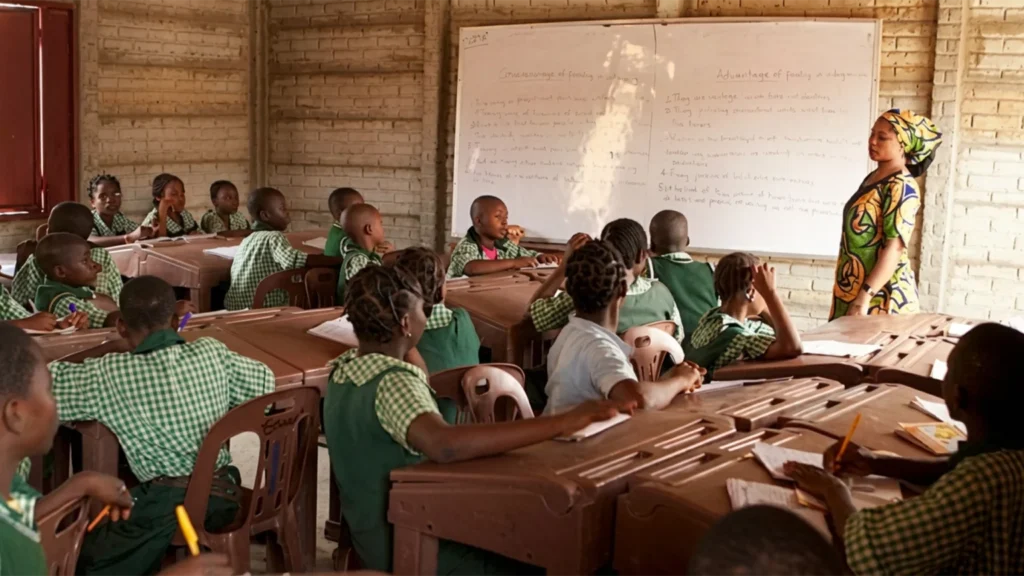
Nigeria’s public schools are increasingly relying on former students, private donors and alumni associations to repair dilapidated buildings, provide learning materials and improve facilities, raising fresh concerns about the adequacy of government funding for education.
Across the country, alumni groups are mobilising resources to renovate classrooms, install solar power systems, equip laboratories, support teachers and award scholarships. While these interventions have helped address immediate needs in some institutions, they also highlight the financial pressures confronting public schools and the growing importance of private contributions to their survival.
A report documented how alumni associations were stepping in to sustain schools amid inadequate government investment. The report highlighted projects ranging from infrastructure rehabilitation to electricity provision and student support, illustrating how former students have become important contributors to the development of their alma maters.
One example was the Queen’s College Old Girls Association, whose 1985 graduating set reportedly invested about ₦15 million in a solar-powered electricity project. Commissioned in November 2025, the installation was designed to provide electricity for 18 classrooms, helping students study during evening preparation periods without depending entirely on noisy generators.
The project demonstrated how alumni contributions can produce tangible improvements in the learning environment. However, it also raised a broader question: why should former students have to mobilise substantial private resources to provide facilities that public education authorities are expected to maintain?
According to UNICEF, government expenditure on education declined from 9.3% of total government spending in 2015 to 3.6% in 2023. The organisation linked persistent underfunding to limited access to schooling and poor learning outcomes.
The report also noted that approximately 30% of learners who reached Junior Secondary School Three in 2021 lacked the foundational reading skills expected to have been acquired during the early primary-school years.
These figures underline the scale of the challenge facing Nigeria’s education system. Although funding alone does not determine educational quality, inadequate investment can restrict the provision of classrooms, textbooks, qualified teachers, electricity, sanitation and other essential facilities.
For schools operating with limited resources, the consequences can extend beyond physical infrastructure to affect attendance, classroom participation and students’ ability to learn effectively.
Alumni interventions have become an important source of support for institutions whose immediate needs may exceed available public resources.
Prof. Tokunbo Adaja, Dean of Postgraduate Studies at Joseph Ayo Babalola University, expressed concern about the growing reliance on old students’ associations to renovate public schools, employ teachers and provide learning materials.
Adaja cited the experience of the 1982 set of Uso Grammar School in Ondo State, which reportedly raised money from personal resources to renovate parts of the institution.
Such interventions reflect a strong sense of responsibility among former students, many of whom regard their contributions as a way of giving back to institutions that helped shape their careers.
Beyond renovation projects, alumni associations can support scholarships, mentorship programmes, career guidance, teacher development and the provision of educational equipment. Their familiarity with their former schools may also help them identify urgent needs and mobilise support more quickly than some conventional funding arrangements.
In Osun State, the Old Students Association of Ilesa Grammar School reported substantial investment in its alma mater during celebrations marking the institution’s 90th anniversary in 2024.
The association said it had spent more than ₦1 billion on over 90 intervention projects, including infrastructure improvements. The scale of the reported contribution demonstrated the potential of organised alumni networks to mobilise resources for school development.
Despite the benefits, dependence on alumni contributions presents important questions about equity and sustainability.
Schools with prominent graduates, wealthy alumni networks or strong fundraising structures may attract substantial donations. Others, particularly institutions in disadvantaged communities, may lack access to comparable financial support.
This creates the risk that the quality of facilities available to students could depend partly on the financial capacity of former students rather than on assessed educational needs and equitable public investment.
A school whose alumni can fund solar power, laboratory equipment and classroom rehabilitation may make faster progress than another institution with equally urgent needs but fewer resources to draw upon.
There is also the question of maintenance. Newly installed facilities require regular servicing, replacement parts and dedicated funding. Without clear maintenance arrangements, projects financed through donations may deteriorate, leaving schools to confront the same problems again.
These concerns make transparency and accountability essential. Alumni associations, school administrators and relevant government agencies need clear agreements on project ownership, procurement, maintenance and the reporting of funds received and spent.
Public authorities should also ensure that private contributions supplement planned government investment rather than become an excuse for reducing it.
The growing involvement of alumni associations presents an opportunity for governments to develop more structured partnerships with former students, private organisations and community groups.
Such partnerships could begin with comprehensive assessments of school needs, followed by clearly costed projects, defined responsibilities and public reporting of expenditure. Alumni representatives could also participate in appropriate school development and oversight structures to help identify priorities and monitor the use of resources.
However, partnerships must operate within a framework that protects public ownership, equitable access and government accountability. Donations should not determine which schools receive basic services, nor should the ability to attract private funding become a condition for adequate public provision.
Governments at federal, state and local levels must continue to prioritise classrooms, teacher recruitment and welfare, instructional materials, sanitation, electricity and the maintenance of existing infrastructure. Budget allocations must also translate into completed projects and measurable improvements in learning conditions.
For their part, alumni associations can strengthen their impact by establishing transparent endowment funds, developing long-term maintenance plans and publishing periodic accounts of their interventions.
Nigeria’s education funding challenge cannot be resolved through donations alone. Alumni contributions can improve facilities and provide opportunities that might otherwise remain unavailable, but they cannot substitute for consistent public financing and effective management.
The growing number of interventions therefore tells two stories: one of former students demonstrating solidarity with the next generation, and another of public schools depending on private goodwill to meet essential needs.
The lasting measure of progress will not be how many dilapidated classrooms alumni can renovate, but whether governments can build and sustain an education system in which every public school has the resources necessary to provide quality learning, regardless of its location or the wealth of its former students.
Alumni associations are increasingly funding renovations and learning facilities in Nigeria’s public schools, highlighting education funding gaps and the need for stronger government investment and accountability.