

South Africa is entering a new political era as the African National Congress (ANC) loses its parliamentary majority that it had held for 30 years. The official results of the country’s general election revealed that the ANC received 40.2% of the vote, a significant drop from the 57.5% it received in This means that the party of Nelson Mandela has won 159 seats in the 400-seat National Assembly, a sharp decline from its previous 230 seats.
This outcome marks a significant development in South Africa’s post-apartheid history, as the ANC will now have to share power. The closest rival to the ANC, the broadly centrist Democratic Alliance (DA), received 21.8% of the vote. However, coalition negotiations are expected to be challenging due to the historical antagonism between the ANC and the DA. Political analyst Oscar van Heerden noted that the DA has long approached the ANC as an enemy.
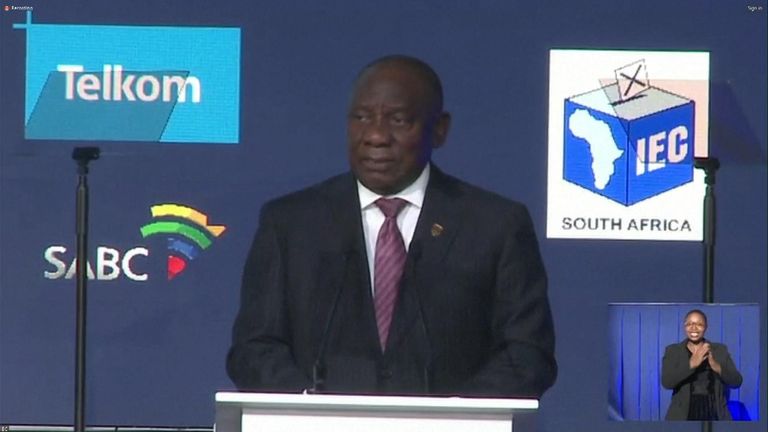
President Cyril Ramaphosa acknowledged the voices of the people of South Africa, stating that their choices and wishes must be respected. He emphasized the need for leaders to work together to meet the needs of the country. The ANC officials admitted that the party was humbled by the result but stood by Ramaphosa, who had previously served as Nelson Mandela’s lead negotiator to end apartheid. Fikile Mbalula, the ANC’s secretary general, acknowledged mistakes made by the party in governance and other areas.
The ANC’s governance over the past decade has generated significant discontent, particularly regarding economic inequality, which is the highest in the world in South Africa. Sky News’s Africa correspondent, Yousra Elbagir, noted that many people, particularly young voters, expressed their frustration with economic inequality through this election. A notable factor in the ANC’s decline was the emergence of a new party, uMkhonto we Sizwe (MK), led by former president Jacob Zuma, which garnered 14.6% of the vote. MK is named after the ANC’s former armed wing.
The far-left Economic Freedom Fighters (EFF), led by former ANC youth leader Julius Malema, secured 9.5% of the vote. The DA has appointed a coalition negotiating team and expressed its readiness to face the challenge. The party aims to prevent what it refers to as a “doomsday coalition” involving formal links between the ANC and either MK or the EFF. The ANC has stated its openness to discussions with all parties.
This shift in South Africa’s political landscape reflects the evolving dynamics and aspirations of its citizens. The country now faces the task of navigating a new era of power-sharing and addressing the pressing issues of economic inequality and governance.