


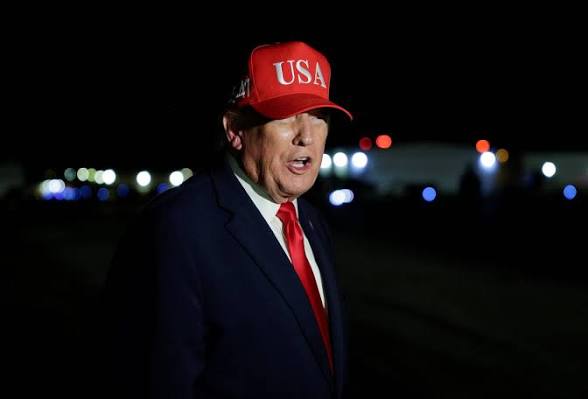
Trump Cancels Livestream Plan for Nidal Hasan’s Execution Following Widespread Backlash.
United States President Donald Trump has reversed plans to livestream the scheduled execution of Nidal Malik Hasan, the former US Army psychiatrist convicted of carrying out the deadly 2009 Fort Hood military base shooting in Texas.
Trump announced the decision on Thursday, October 15, following mounting criticism from lawmakers, military figures, religious leaders and members of the public who questioned the ethics and implications of broadcasting an execution.
Although the livestream has been cancelled, the president said Hasan’s execution by firing squad would proceed as scheduled on December 3, 2026. He also indicated that immediate family members of the victims would be permitted to witness the execution in person if they wished.
The reversal followed an earlier announcement by US Defence Secretary Pete Hegseth that the military intended to make the execution publicly viewable. Hegseth had defended the proposal as a potential deterrent against terrorism and a demonstration of how the United States deals with individuals convicted of terrorist violence.
However, the plan provoked significant opposition across the American political spectrum, with critics arguing that broadcasting a state sanctioned killing could turn the administration of justice into a public spectacle.
According to Reuters, CBS News and The Washington Post, the decision represents a reversal of the Pentagon’s earlier position after growing political and public pressure.
Fort Hood Shooting and Hasan’s Conviction
Hasan, a former US Army major and psychiatrist, was convicted in 2013 by a military court for the November 5, 2009, shooting at Fort Hood, now known as Fort Cavazos, in Texas.
The attack killed 13 people and wounded 32 others, making it one of the deadliest shootings on a US military installation.
A military jury found Hasan guilty of multiple counts of premeditated murder and attempted murder and sentenced him to death. His case has remained a significant chapter in debates surrounding military security, terrorism and the death penalty in the United States.
The planned execution by firing squad would be an exceptionally rare event in modern US military history. The last military execution in the country took place in 1961, while the last execution by firing squad occurred in 1945.
Lawmakers and Human Rights Concerns
The proposed livestream drew criticism from both Republican and Democratic lawmakers, some of whom argued that broadcasting an execution would undermine the dignity of the judicial process and risk providing propaganda material to extremist organisations.
Critics also questioned whether a public broadcast would serve any meaningful security purpose, warning that images of an execution could be exploited by groups seeking to portray the United States negatively.
The United Nations human rights office also raised concerns about the proposed broadcast, warning that publicly displaying an execution could raise serious questions under international human rights law.
Meanwhile, religious leaders and other public figures expressed reservations about the ethics of turning an execution into a widely accessible media event.
The controversy highlighted a distinction between supporting a court-imposed death sentence and supporting the public broadcasting of the punishment. While some lawmakers maintained that Hasan should face his sentence, they opposed making his death available for mass viewing.
Public Opinion and the Debate Over Capital Punishment
Public reaction also contributed to the controversy. A Washington Post-ABC News Ipsos poll reported that approximately eight in 10 Americans opposed live streaming Hasan’s execution, even though a narrower majority supported carrying out the death sentence.
The findings suggest that opposition to broadcasting the execution extends beyond those who oppose capital punishment itself.
Trump acknowledged the objections in his announcement, noting that although a livestream might have been intended to demonstrate the consequences of terrorism, many people would prefer not to watch someone die.
His decision to cancel the broadcast does not, however, resolve the wider debate over capital punishment, military justice or the circumstances under which the state should carry out executions.
Questions about the scheduled execution also remain subject to applicable military procedures and any legal developments that could affect its implementation.
What the Decision Means
The cancellation marks a significant retreat from a controversial proposal that had attracted domestic and international scrutiny.
For the Trump administration, the episode illustrates the political and ethical challenges of presenting executions as a public deterrent, particularly when the decision involves a military institution and a case with profound consequences for victims, survivors and their families.
For critics, the reversal reinforces concerns about the risks of broadcasting state executions, including the potential to turn punishment into spectacle and provide material that extremist groups could exploit.
The immediate outcome is clear: the planned livestream has been cancelled, but Hasan’s execution remains scheduled for December 3, 2026, according to Trump’s announcement.
The broader debate over the death penalty, public accountability and the limits of government power is likely to continue as the scheduled date approaches.