

U.S. President Donald Trump formally welcomed Nigeria’s Ambassador to the United States, Kayode Are, at the White House on Monday, May 25, 2026, in a move Nigerian civil society leaders say signals renewed momentum for bilateral relations between the two countries.
The meeting marked Ambassador Are’s official resumption of duty in Washington and was attended to by senior U.S. officials in the Oval Office. Nigerian groups say the reception reflects growing U.S. interest in deepening engagement with Africa’s largest economy across security, trade, and development.
The reception drew praise from the Civil Society Organisations on Community Advancement and Humanitarian Empowerment Initiative (CSCHEI), a United Nations-recognized platform coordinating accredited civil society and community-based organizations in Nigeria.
In a statement signed by Director-General Hon. Kunle Yusuff, CSCHEI commended President Bola Tinubu for appointing Are, describing the choice as “a strategic step towards strengthening bilateral ties.”
The group argued that Are’s background in security, intelligence, and international relations positions him to advance Nigeria’s interests effectively in Washington.
“Nigeria’s longstanding partnership with the United States continues to deliver benefits across key sectors, including education, healthcare, security, oil and gas, industry, and aviation,” the statement said. “Appointing a diplomat with this profile will deepen cooperation in those areas.”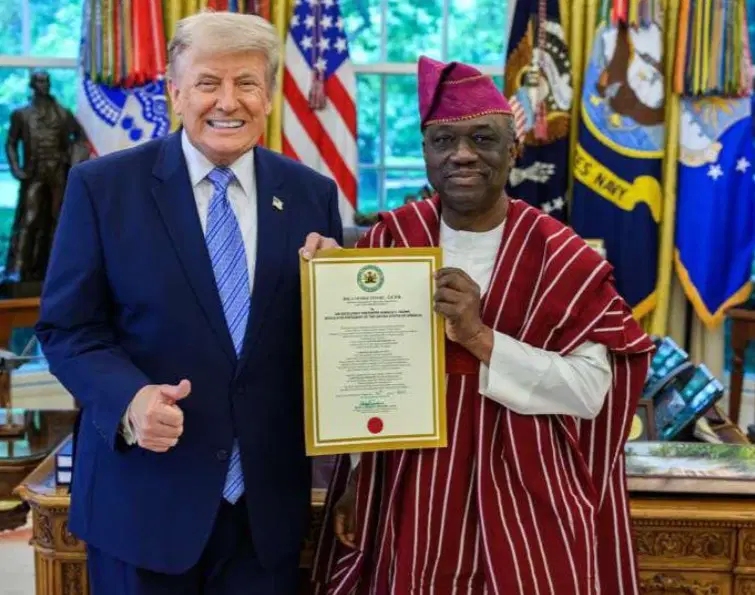

CSCHEI also thanked the U.S. government for accepting Ambassador Are’s credentials and facilitating the start of his assignment.
Africa United Congress USA, a development partner of CSCHEI, echoed the view. The group said Are’s “professional record, diplomatic experience, and reputation for integrity” make him well-placed to manage complex U.S.–Nigeria issues and open new channels for collaboration
Ambassador Are’s reception by President Trump is being read in Abuja and Washington as more than ceremonial. Analysts note that high-level diplomatic receptions often precede renewed policy engagement, particularly on security cooperation and economic partnerships.
Nigeria remains a key U.S. partner in West Africa on counterterrorism, maritime security in the Gulf of Guinea, and regional stability. The U.S. has also been a major partner in Nigeria’s health sector, particularly in malaria, HIV/AIDS, and primary healthcare programs, as well as in energy and aviation.
CSCHEI said it expects the new diplomatic phase to create “fresh opportunities for partnerships involving US-based international NGOs, development agencies, and accredited CSOs and CBOs in Nigeria.” The organization pointed to development-driven diplomacy as a likely focus, with greater involvement of civil society in joint programs.
“The global community witnessed the official presentation at the Oval Office of the White House on Thursday, May 21,” the statement said. “Capacity and performance in diplomacy are evident, and accredited civil society and community-based organisations in Nigeria are proud of Ambassador Kayode Are’s representation of the country
Ambassador Kayode Are is a career diplomat with decades of experience in Nigeria’s security and foreign policy institutions. Before his posting to Washington, he held senior roles in intelligence and international relations, giving him direct exposure to the issues that dominate U.S.–Nigeria dialogue.
His appointment comes at a time when both countries are recalibrating engagement on regional security, trade under the African Growth and Opportunity Act, and cooperation on energy transition. Nigerian officials have repeatedly called for a shift from aid-based relations to investment and technology partnerships, and Are’s mandate is expected to reflect that priority.
The U.S. and Nigeria maintain one of the most substantial relationships in sub-Saharan Africa. Trade between the two countries exceeded $10 billion in recent years, with oil and gas, agriculture, and manufactured goods making up the bulk of exchanges.
On security, cooperation has focused on countering Boko Haram and ISWAP in the Lake Chad Basin, training Nigerian forces, and intelligence sharing. In health, U.S. support through PEPFAR and USAID has underpinned Nigeria’s response to HIV/AIDS, polio eradication, and maternal health.
Diplomatic observers say the Trump administration’s engagement with African partners has increasingly emphasized trade, energy, and security over traditional aid. Are’s arrival aligns with that shift, giving Nigeria a direct channel to negotiate on investment facilitation, visa and migration issues, and defense cooperation
For Nigerian civil society, the priority is translating high-level diplomacy into tangible programs at the community level. CSCHEI said it anticipates more structured collaboration between U.S. agencies and Nigerian CSOs on governance, humanitarian response, and youth employment.
The group also expects the embassy in Washington to play a stronger role in connecting Nigerian businesses with U.S. investors, particularly in technology, agriculture, and renewable energy.
On the U.S. side, officials have signaled interest in expanding private-sector-led growth in Africa and in countering illicit finance and insecurity that affect regional stability. Ambassador Are’s experience in security is likely to be central to those discussions
Ambassador Are now faces the task of converting diplomatic goodwill into concrete outcomes. For Abuja, a successful tenure would mean more U.S. investment, closer security collaboration, and greater U.S. support for Nigeria’s regional leadership role.
For Washington, a stable and economically stronger Nigeria is seen as critical to U.S. interests in West Africa and to broader counterterrorism and trade objectives on the continent.
The meeting at the Oval Office may have lasted only minutes, but its impact will be measured over the next two years in the agreements signed, the investments secured, and the security cooperation delivered