


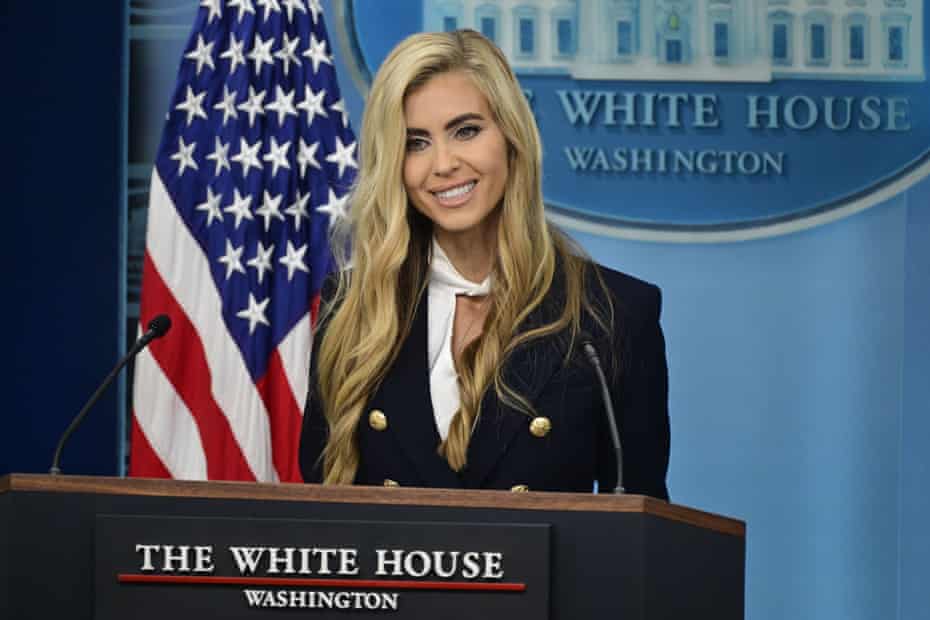
United States President Donald Trump’s newly appointed White House press secretary, Katie Zacharia, has faced criticism following a brief and awkward first appearance before journalists, raising questions about her readiness for one of the administration’s most demanding communications roles.
Zacharia made her debut at the White House press briefing room.Her appearance lasted approximately 14 minutes, during which she delivered prepared remarks praising Trump’s leadership and policies before taking questions from reporters representing only three media organisations.
Her heavily scripted presentation, occasional verbal missteps and limited engagement with journalists prompted criticism from media commentators, with some mockingly describing her performance as robotic and dubbing her the “Zachbot”.
The nickname, which reflects perceptions of her mechanical delivery, has become a defining feature of the reaction to her first briefing.
During the briefing, Zacharia fielded questions from Breitbart News, Fox News and the Daily Mail. One particularly significant question concerned whether the United States had suspended intelligence-sharing with Ukraine amid heightened tensions involving the Trump administration and Ukrainian President Volodymyr Zelensky.
Zacharia said she would have to provide an answer later, leaving the issue unresolved during her appearance.
The question was significant given the strategic implications of American intelligence support for Ukraine and the wider security consequences of Washington’s evolving relationship with Kyiv.
Her handling of the question underscored the challenges facing a press secretary expected to communicate the administration’s position on sensitive foreign policy matters while responding to an often-demanding White House press corps.
Another awkward moment occurred when Zacharia discussed balancing her new responsibilities with family life. During her remarks, she briefly referred to Trump as her president before correcting herself to say her husband, prompting a moment of humour in the briefing room.
However, the most consequential announcement of the session concerned Kimberly Guilfoyle, the United States ambassador to Greece.
Zacharia confirmed that the administration had asked Guilfoyle to resign following reports alleging improper conduct before and during her tenure in Athens. The allegations have attracted scrutiny, although they should not be treated as established wrongdoing without appropriate verification.
Despite the criticism surrounding the briefing, Trump publicly praised Zacharia’s performance when reporters questioned him about her first appearance.
The president described her performance as excellent, signalling his confidence in the new press secretary despite the mixed reaction from political observers and journalists.
Zacharia previously worked as a conservative media commentator, appearing on Fox News and Newsmax. She also served briefly as a spokesperson for the Department of Homeland Security and worked as a communications adviser for Trump Media & Technology Group, the company associated with the Truth Social platform.
Trump announced her appointment on October 9, 2026, selecting her to succeed Karoline Leavitt, who left the position in August to spend more time with her family.
In announcing the appointment, Trump described Zacharia as a loyal supporter and expressed confidence in her ability to communicate his administration’s agenda.
Her background in conservative media provides experience in political messaging and television commentary. However, the White House press secretary’s position demands more than effective advocacy. It requires factual accuracy, command of government policy, the ability to handle difficult questions and a willingness to engage with journalists representing different perspectives.
The controversy surrounding Zacharia’s debut highlights a broader debate over the relationship between political communication, media access and government transparency under the Trump administration.
A White House press secretary serves as a central link between the president, the administration and the public. The position requires the official to explain policy decisions, clarify government statements, address controversies and respond to scrutiny on matters affecting domestic and international affairs.
The decision to end Zacharia’s first briefing after only three journalists had asked questions attracted particular attention. Although she cited Trump’s scheduled departure for a trip to Alaska as the reason for concluding the session, the limited opportunity for questioning fuelled criticism of the administration’s approach to media engagement.
The performance also drew renewed attention to the importance of distinguishing political messaging from substantive answers on issues of public concern.
For international observers, including African governments and policymakers, the White House communications approach matters because American decisions on security, trade, diplomacy and international development can have consequences far beyond the United States.
Washington’s positions on Ukraine, global security and relations with other countries are particularly relevant to governments assessing American foreign policy priorities and their potential implications for Africa.
Zacharia’s first appearance does not, by itself, establish how effectively she will perform in the position over the longer term. Nevertheless, the reaction illustrates the immediate scrutiny facing a press secretary whose credibility will depend on her ability to provide clear answers, maintain professional composure and communicate government decisions accurately.
As she settles into the role, her handling of difficult questions and her willingness to engage with a broad range of journalists will be important measures of her effectiveness.
For now, the “Zachbot” label has overshadowed her first briefing. Whether that perception persists will depend on what follows: more confident performances, greater command of policy details and a demonstrable commitment to answering questions on behalf of the administration.
Donald Trump’s new press secretary, Katie Zacharia, faces criticism after a brief, scripted White House debut raises questions about media engagement and policy communication.