


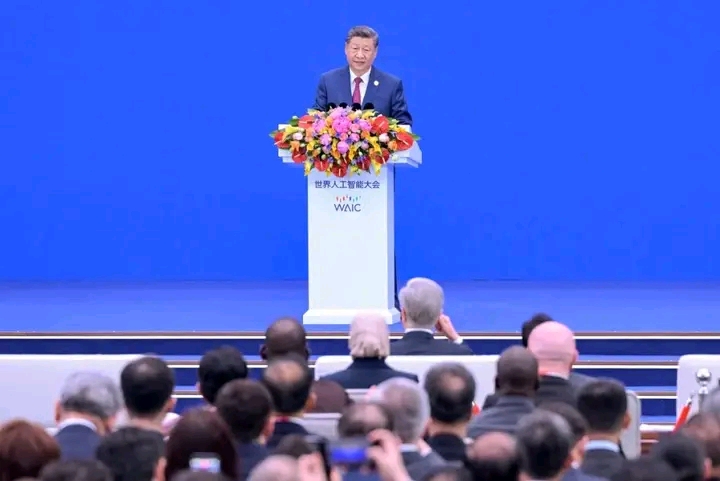
“Xi Jinping Rejects Single Country Control of Artificial Intelligence, Calls for Global Cooperation on AI Governance”
Chinese President Xi Jinping has called for greater international cooperation in the development and governance of artificial intelligence, warning that the rapidly advancing technology should not be controlled or dominated by a single country.
Speaking at the opening of the 2026 World Artificial Intelligence Conference and High Level Meeting on Global AI Governance in Shanghai on Friday, July 17, Xi said AI development should become a product of international collaboration rather than a competition led by one nation.
“AI development should not be a solo performance by a single country, but a symphony of international cooperation,” Xi said, according to reports by Reuters and other international media outlets.
The Chinese leader also urged countries to oppose what he described as the excessive expansion of national security considerations into the AI sector. He warned against placing one country’s security interests above those of others, as global powers increasingly compete over advanced AI systems, semiconductors, computing infrastructure and technology standards.
Xi’s remarks come amid growing strategic rivalry between China and the United States over leadership in artificial intelligence. Washington and the European Union have imposed various technology restrictions on China, citing national security concerns, while Beijing has increasingly promoted international cooperation, open source AI development and broader access to the technology.
China has also sought to strengthen its influence in global AI governance. On Thursday, representatives from 29 countries signed an agreement to establish the World AI Cooperation Organization, an intergovernmental body headquartered in Shanghai. The organisation is expected to focus on international cooperation and the development of global frameworks for AI governance.
Xi further highlighted the need to address the widening global technology divide, particularly between advanced economies and developing countries. China has pledged initiatives aimed at expanding AI training and technological cooperation with countries in the Global South, including nations in Africa, Asia and Latin America.
The debate over who should set the rules for artificial intelligence has become increasingly important as AI systems expand into healthcare, education, finance, defence, communications and other critical sectors. Governments and technology companies are now grappling with questions surrounding safety, accountability, privacy, misinformation and the potential misuse of AI by criminals and armed groups.
While China’s call for a more inclusive global approach has resonated with many developing countries seeking greater access to emerging technologies, the country’s growing role in shaping international AI standards is also part of a broader geopolitical contest over the future of technology governance.
Xi’s intervention therefore reflects both a call for multilateral cooperation and China’s ambition to play a central role in determining how artificial intelligence is developed, regulated and accessed around the world.