

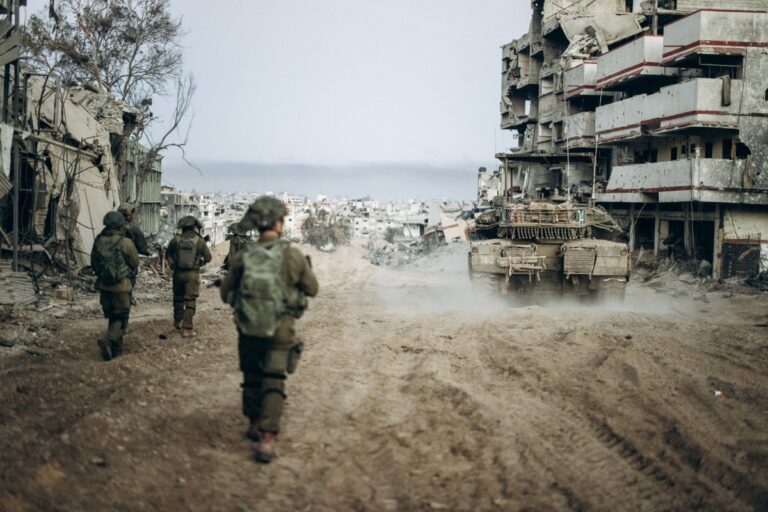
On August 12, 2024, a significant escalation in the ongoing conflict in Gaza prompted hundreds of residents to flee their homes in the northern neighborhoods of Khan Yunis. The Israeli military issued urgent evacuation orders as it prepared for a new offensive against Palestinian militants believed to be taking refuge in the area. This development comes amidst a backdrop of continuing violence and humanitarian crises in Gaza.
Early in the morning, the Israeli army disseminated evacuation notices through leaflets and mobile phone messages, specifically targeting the Al-Jalaa area of Khan Yunis, which had previously been deemed a humanitarian safe zone. The military warned residents that the Al-Jalaa neighborhood would soon become a “dangerous combat zone,” leading many families, already displaced multiple times during the ongoing conflict, to hastily gather their belongings and seek shelter elsewhere.
Witnesses reported seeing large groups of people, particularly from the Hamad neighborhood in Al-Jalaa, fleeing with whatever possessions they could carry. Families loaded their vehicles with essential items such as mattresses, clothing, and cooking utensils, while others opted to walk with bags in hand. The urgency of the situation was palpable as young men and women assisted elderly relatives, and some sought transportation to safer locations.
In a statement, the Israeli Defense Forces (IDF) emphasized the necessity of the evacuation, stating, “The IDF is about to operate against the terrorist organizations in the area and therefore calls on the remaining population left in the Al-Jalaa neighborhood to temporarily evacuate.” This directive came as Khan Yunis, the main southern governorate of Gaza, had already experienced multiple evacuation orders and extensive bombardment that had left vast residential areas in ruins.
The United Nations refugee agency for Palestinian refugees, UNRWA, highlighted the dire situation, noting that in just the past few days, more than 75,000 people had been displaced in southwestern Gaza. Philippe Lazzarini, the agency’s head, expressed deep concern for those fleeing, stating, “Some are only able to carry their children with them, some carry their whole lives in one small bag. The people of Gaza are trapped and have nowhere to go.”
As the evacuation unfolded, further violence erupted in Khan Yunis. Reports indicated that Israeli airstrikes injured several civilians, who were subsequently treated at Nasser Hospital. Local resident Awad Barbakh recounted the chaos, stating, “They were all civilians and they were shopping in the market when a missile hit and left people lying in the streets.” This incident underscores the tragic reality that civilians often bear the brunt of military operations in densely populated areas.
The ongoing conflict in Gaza escalated dramatically following a surprise attack by Hamas on Israel on October 7, 2023. This attack resulted in significant casualties, with official Israeli figures indicating the deaths of 1,198 individuals, primarily civilians. Additionally, militants captured 251 people, with 111 still held hostage in Gaza, according to the Israeli military, which has stated that 39 of these captives are believed to be deceased.
In retaliation, Israel’s military offensive in Gaza has resulted in staggering casualties, with the Hamas-run health ministry reporting at least 39,790 deaths, though it does not differentiate between civilian and militant fatalities. The cycle of violence continues to devastate the region, compounding the humanitarian crisis and leaving countless families displaced and in desperate need of assistance.
As the situation develops, the plight of Gazans remains critical, with many facing an uncertain future amid ongoing military operations and a deteriorating humanitarian landscape. The international community watches closely, hoping for a resolution to the conflict that has caused immense suffering and loss of life.