


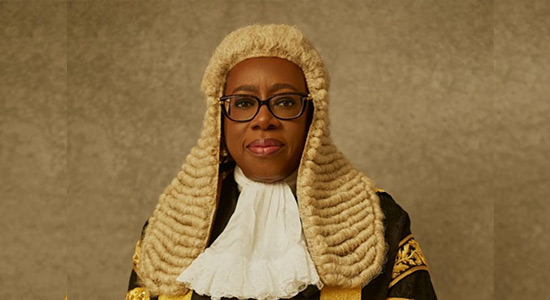
In a significant development for Nigeria’s judicial system, the National Judicial Council (NJC) is set to forward the name of Justice Kudirat Kekere-Ekun to President Bola Tinubu for approval as the next Chief Justice of Nigeria (CJN). This important decision follows a recommendation made during the NJC’s 106th meeting, which took place on Thursday and was presided over by the outgoing CJN, Justice Olukayode Ariwoola.
Justice Kekere-Ekun’s nomination marks a pivotal moment in Nigerian history, as she stands to become only the second woman to hold the esteemed position of Chief Justice in the country. The first was Justice Mariam Mukhtar, who served from July 2012 until November 2014. The NJC’s Director of Information, Soji Oye, confirmed that following the conclusion of the meeting, the next step involves formally submitting Justice Kekere-Ekun’s name to the President for his endorsement.
“The meeting just finished today, so tomorrow is when My Lord’s name will be taken to the President for his approval of her as the next CJN,” Oye stated, highlighting the procedural steps being taken to ensure a smooth transition in leadership.
Justice Ariwoola, who will retire from his position on August 22, 2024, has played a significant role in guiding the judiciary during his tenure. His impending departure underscores the urgency of appointing a successor who can continue to uphold the integrity and effectiveness of the judicial system.
In addition to Justice Kekere-Ekun’s nomination, the NJC made several other recommendations during the same meeting. A total of 27 candidates were proposed for appointment as judges of various state high courts, along with one candidate for the position of Kadi (a judge in Islamic law) for the Sharia Court of the Federal Capital Territory, Abuja. These recommendations will also be forwarded to the respective state governors and the President for their approval.
Among the candidates recommended for the state high courts, several notable names have emerged from different states. For Kwara State, six candidates were put forward: Olawoyin Olabisi, Abdulrazaq Funsho, Folorunsho Muritala, Dikko Adebayo, Adeniyi Adenike, and Osuolale-Ajayi Olalekan. Kaduna State has one candidate, Zubairu Ja’afaru, while Benue State has four candidates: Kor Tersoo, Ikwulono Maimuna, Adagba Julie, and Tor Tersugh. Additionally, Benue has two candidates for the Customary Court of Appeal: Onche Inalegwu and Igba Terhile.
Rivers State has seen a more extensive list, with eight candidates nominated for the high court: Onyiri Frank, Ugoji Chinedum, Obomanu Vidal, Oguguo Chituru, Fubara Elkanah, Kokpan Sylvester, Obu Madighi, and Wifa-Adedipe Lesi. Ondo State also submitted six candidates: Daomi Adebisi, Fabuluje William, Ogunwumiju Idowu, Demehin-Ogunbayo Happiness, Kpemi Justinah, and Adegoroye Adeola.
Once approved by the President and the respective state governors, these candidates are expected to be sworn in, marking a new chapter in Nigeria’s judiciary. The NJC’s actions reflect a commitment to strengthening the judicial system and addressing the need for capable and diverse leadership in the courts.
As the nation anticipates the President’s decision regarding Justice Kekere-Ekun’s nomination, the legal community and the public at large are hopeful for a smooth transition that will continue to uphold justice and the rule of law in Nigeria.