


US President Donald Trump has warned that the United States will target Iran’s bridges and power plants next week if Tehran does not agree to resume negotiations, as hostilities between the two countries entered a fourth day.
The comments were made in a Fox News interview with Bret Baier and aired Tuesday night, hours after the US carried out a seven-hour wave of strikes in the region and resumed a naval blockade of Iranian ports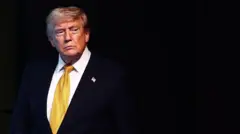
Speaking on _Special Report_, Trump said US negotiators had delivered a message to Iranian officials on Tuesday evening.
“We’re going to knock out all their power plants. We’re going to knock out all their bridges unless they get to the table and negotiate,” Trump said. “Next week it gets really bad for them.”
He added: “I’ll save the energy targets for last, but ultimately we’ll hit energy targets,” and quoted the message to Iran as: “’better make a deal, or you’re not going to have anything left’.”
It is not the first time this year Trump has threatened civilian infrastructure. In April he made similar remarks about bombing bridges and power plants. At the time, UN human rights chief Volker Türk responded that “under international law, deliberately attacking civilians and civilian infrastructure is a war crime.” The 1949 Geneva Conventions prohibit attacks on sites essential for civilian survival.
The threat came as the US intensified military operations around the Strait of Hormuz. US Central Command said it hit “dozens” of Iranian military targets near the waterway, aiming to “further degrade Iran’s ability to threaten commercial shipping and civilian crews.”
Iran responded with missile and drone attacks on US targets in Jordan, Kuwait and Bahrain, according to Iranian state TV. In the early hours of Wednesday, Kuwait said its air defences were engaging Iranian drones, while Bahrain activated air raid sirens and urged residents to seek shelter.
The United Arab Emirates reported that Iranian cruise missiles struck two of its tankers on Monday night, killing one Indian crew member and wounding eight others. Iran’s Islamic Revolutionary Guard Corps later said the tankers had ignored warnings, turned off navigation systems and tried to pass through a mined route.
Centcom also accused Iran of “intentionally targeting civilians” by attacking seven commercial ships, resulting in “nearly a dozen civilian crew members killed, missing, or injured.”
At least seven Iranian military personnel were killed in US strikes on a base in Bampur in southeastern Iran, Iran’s army said.
The escalation followed a sudden policy shift on the Strait of Hormuz, one of the world’s most critical oil chokepoints.
On Monday, Trump declared the US was now the “guardian” of the strait and proposed a 20% charge on all cargo passing through to pay for protection. By Tuesday, he reversed that plan.
“I have decided to replace the 20% United States Reimbursement Fee with Trade and Investment Deals that the various Gulf States will be making into the United States,” Trump wrote on Truth Social. “Those Investments will be MASSIVE but, at the same time, extraordinarily good for them, and their future.”
He offered no details. Speaking later after talks in Washington with Iraqi Prime Minister Ali al-Zaidi, Trump said: “I don’t like the concept of a fee, but at the same time, it’s not fair that we’re protecting this Strait for the entire world.” He said Gulf leaders had called him to object.
At the same time, Trump announced the US would reimpose its naval blockade on Iranian ports. The US first imposed such a blockade in April. Roughly five weeks later it was lifted as part of a memorandum of understanding aimed at ending hostilities, but tensions over Hormuz have since reignited.
Trump said the strait “is open to ALL Ship traffic except for Iran” and that “oil is flowing like never before, thanks to the awesome Power of the United States Military.”
Iran rejected the US position. Deputy Foreign Minister Kazem Gharibabadi told state television that the blockade “has, in a way, dismantled” the earlier truce deal. He also said: “If the US thinks that by tightening its measures against us, its military actions and its economic blockade, we will return to negotiations, it is making a mistake.”
Iran maintains it remains in control of the Strait of Hormuz.
The renewed fighting has already hit global markets. Shipping data shows traffic through the strait has slowed to a two-month low, and the benchmark Brent Crude price has risen sharply. Roughly 20% of the world’s oil passes through Hormuz, making any disruption a direct threat to the global economy.
The US and Iran have now been exchanging fire for four days. The US says its strikes are aimed at degrading Iran’s ability to attack shipping. Iran says it is responding to American aggression and a blockade of its economy.
Trump’s latest threat to hit bridges and power plants raises the stakes significantly. Targeting civilian infrastructure would mark a major escalation and likely draw renewed condemnation under international humanitarian law.
For now, the White House says the door to talks remains open, but only on US terms. Tehran says pressure will not bring it back to the table.
With oil prices climbing, shipping slowed, and missiles flying across the Gulf, the conflict has moved from rhetoric to direct confrontation. Whether either side returns to negotiations in the coming week may determine how far the US is willing to go with the strikes Trump has promised