



Reported by Musa Antiketu,| Journalist at Obaland magazine.
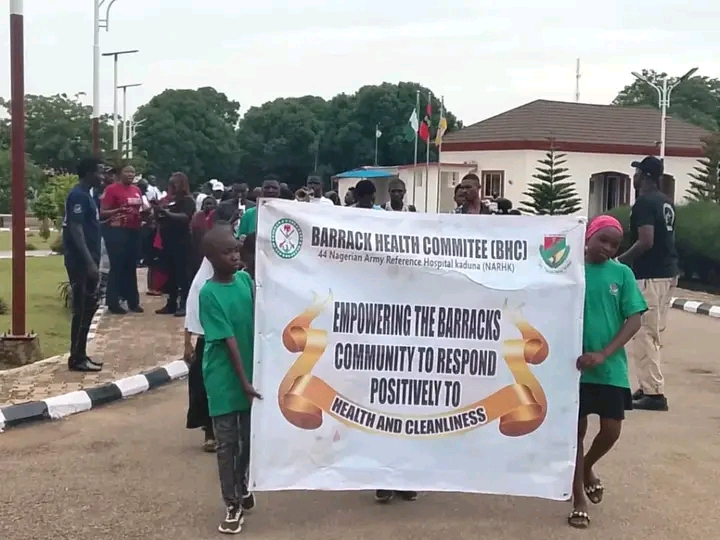
KADUNA, Nigeria — The 44 Nigerian Army Reference Hospital, Kaduna, has intensified its call for improved personal and environmental hygiene among residents of military barracks, warning that stronger sanitation practices are essential to preventing the spread of communicable diseases and protecting the health of families within the military community.
The appeal, according to a report on activities of the hospital’s Barracks Health Committee, places particular emphasis on maintaining clean living environments, observing personal hygiene and encouraging residents to take greater responsibility for disease prevention.
The initiative reflects a broader public-health principle: that disease prevention does not begin only inside hospitals but also within homes, schools, workplaces, communal spaces and other environments where people live and interact.
The Barracks Health Committee of the 44 Nigerian Army Reference Hospital has been promoting education, hygiene and environmental sanitation as part of efforts to improve the general wellbeing of residents. The hospital’s chaplain, Capt. Emeka Ibekwe, said the programme was driven by the vision of the hospital’s Chief Medical Director, Brig.-Gen. Godwin Ogoh, to develop the barracks community into one of the best in the country.
Hygiene placed at the centre of disease prevention
The hospital’s intervention highlights the importance of preventive healthcare in densely populated communities, including military barracks where families, children and personnel live in close proximity.
Poor sanitation, contaminated water, unsafe waste disposal and inadequate personal hygiene can create conditions in which infectious diseases spread more easily. For communities seeking to reduce preventable illnesses, health authorities routinely emphasise clean surroundings, safe water, proper waste management, hand hygiene and early attention to symptoms.
For the military community in Kaduna, the message is particularly significant because the health of service personnel is closely connected to the wellbeing of their families and the wider barracks environment.
The Barracks Health Committee was established to promote standards of cleanliness, education and general wellbeing among residents, with parents encouraged to maintain clean environments around their homes and children encouraged to participate in programmes that support both health and academic development.
While the initiative includes educational activities for children, its underlying objective is broader: to build a culture in which preventive health becomes part of everyday life rather than an emergency response after illness has already emerged.
Cholera and tuberculosis remain public-health concerns
Cholera and tuberculosis are among the diseases that underline the importance of sustained public-health vigilance in Nigeria.
Cholera is primarily associated with the ingestion of food or water contaminated with Vibrio cholerae. Outbreaks can become particularly serious where access to safe drinking water, sanitation and hygiene is inadequate. Rapid onset of severe diarrhoea and dehydration can make cholera life-threatening without prompt treatment.
Tuberculosis, on the other hand, is primarily transmitted through the air when people with infectious pulmonary TB cough, sneeze or speak. Unlike cholera, it is not principally a sanitation-related disease. However, crowded living conditions, delayed diagnosis and inadequate infection-control practices can contribute to its transmission.
This distinction is important because public-health messaging should avoid suggesting that all infectious diseases have the same causes or prevention mechanisms.
For cholera, safe water, sanitation, food safety and hand hygiene are central preventive measures. For tuberculosis, early identification and treatment, respiratory hygiene, adequate ventilation, contact tracing and adherence to treatment are particularly important.
Nigeria continues to face a substantial burden of communicable diseases. Research involving the 44 Nigerian Army Reference Hospital has also examined tuberculosis among patients attending health facilities in Kaduna, demonstrating the relevance of TB prevention, diagnosis and treatment within the state’s healthcare system.
A hospital serving beyond the battlefield
The 44 Nigerian Army Reference Hospital in Kaduna occupies an important position within Nigeria’s military healthcare system.
The hospital is operated under the Nigerian Army Medical Corps and has developed into a major tertiary medical facility. Its responsibilities extend beyond the treatment of military personnel wounded during operations to include specialist medical services and healthcare support for members of the wider community.
The Ministry of Defence has previously highlighted the hospital’s expanding infrastructure and medical capabilities. In 2023, the ministry reported that its Permanent Secretary at the time, Dr Ibrahim Abubakar Kana, inspected the facility and described its services and facilities as among the best in the world. The visit included the hospital’s prosthetics and orthotics workshop and physical rehabilitation centre.
More recently, the Ministry of Defence reported the completion of a 100-bed accommodation facility for medical interns at the hospital, describing the development as part of efforts to strengthen healthcare delivery and medical training infrastructure within the Armed Forces.
The hospital’s role therefore extends beyond clinical treatment. Its engagement with barracks residents on hygiene and community wellbeing demonstrates the preventive-health dimension of military medicine.
Health education begins with the community
One of the notable aspects of the Barracks Health Committee’s programme is the recognition that health education must involve the entire community.
Children, for instance, can become important agents of behavioural change when they are taught basic principles of hygiene, cleanliness and disease prevention at an early age.
Parents also have a critical role. Maintaining clean surroundings, disposing of household waste responsibly, protecting drinking water from contamination and ensuring that sick family members receive appropriate medical attention can help reduce health risks.
The committee’s activities have included academic examinations for children living within the barracks. According to Capt. Ibekwe, 46 candidates participated in the first stage, with 25 progressing to the second stage. Twelve were expected to reach the subsequent stage, while six would eventually emerge from the final competition.
Although the examination programme is primarily educational, its connection with the committee’s wider mission is significant. A healthy community requires not only medical services but also informed citizens capable of understanding and responding to health risks.
The committee has indicated that the educational programme will be sustained quarterly, with plans for inter-barracks competitions. There is also an ambition to develop the initiative into a scholarship platform for outstanding students and their families.
Prevention is cheaper than crisis response
The renewed emphasis on hygiene also raises a wider issue for Nigeria’s healthcare system: the importance of investing in prevention rather than relying overwhelmingly on treatment.
Hospitals are indispensable when people become sick, but many communicable diseases can be reduced through relatively basic interventions. Clean water, functional sanitation systems, responsible waste disposal, health education, vaccination where applicable, early diagnosis and effective disease surveillance can prevent illnesses from becoming large-scale public-health emergencies.
Nigeria has experienced repeated outbreaks of infectious diseases, including cholera and Lassa fever. In 2024, the Nigeria Centre for Disease Control and Prevention was notified of suspected viral haemorrhagic fever deaths linked to the 44 Nigerian Army Reference Hospital in Kaduna. Subsequent investigations identified confirmed Lassa fever cases, prompting public-health response measures involving the Kaduna State Ministry of Health and national authorities.
That episode illustrates why disease surveillance and infection prevention must remain continuous rather than activated only after an outbreak occurs.
It also reinforces the importance of collaboration between military medical institutions, state health authorities and national public-health agencies.
Clean barracks, healthier personnel
For the Nigerian Army, maintaining healthy barracks communities has implications beyond individual welfare.
Military effectiveness depends significantly on the physical and mental wellbeing of personnel. Preventable illness can affect attendance, operational readiness, family welfare and the capacity of medical facilities to respond to more serious emergencies.
A strong preventive-health culture can therefore support both military preparedness and community welfare.
The emphasis on environmental hygiene is also relevant to the families of soldiers, many of whom may include children and elderly relatives. When barracks communities are properly maintained, the benefits can extend to schools, recreational areas, markets, religious centres and other shared spaces.
Such measures should ideally be supported by adequate infrastructure. Public awareness alone cannot solve sanitation problems where residents lack reliable water supplies, waste-collection services, functional drainage systems or sufficient toilet facilities.
For this reason, community responsibility must be matched by institutional support.
Sustaining the initiative
The challenge now is to ensure that the hygiene campaign becomes a sustained community practice rather than a short-term programme.
Regular health education sessions, environmental sanitation exercises, disease surveillance, access to clean water and proper waste-disposal systems could reinforce the objectives of the Barracks Health Committee.
The hospital could also strengthen collaboration with public-health institutions in Kaduna to provide residents with accurate information about symptoms, prevention, testing and treatment of infectious diseases.
Particular attention should be paid to vulnerable groups, including children, pregnant women, elderly residents and people living with conditions that may increase their susceptibility to infections.
Health communication should also be clear about when residents should seek professional medical care. Persistent cough, unexplained weight loss, prolonged fever or other symptoms associated with tuberculosis should not be ignored. Similarly, severe diarrhoea and dehydration require urgent medical attention because cholera can progress rapidly.
Residents should avoid self-medication where serious symptoms are present and should instead seek assessment from qualified healthcare professionals.
Broader implications for Nigeria
The message emerging from Kaduna has relevance beyond military barracks.
Across Nigeria, community-level prevention remains an essential component of public health. Urban expansion, population growth, inadequate sanitation infrastructure and seasonal flooding can create conditions that increase the risk of communicable diseases.
Military communities can serve as useful examples of how organised institutions can combine healthcare delivery with education and preventive interventions.
The 44 Nigerian Army Reference Hospital’s approach demonstrates that a modern healthcare institution cannot be defined solely by its operating theatres, diagnostic equipment or specialist doctors. Its wider responsibility includes helping people understand how to stay healthy before they require hospital treatment.
For Obaland magazine, the central lesson is clear: disease prevention is a shared responsibility.
Government institutions must provide the infrastructure and healthcare systems required for safe living. Medical professionals must provide credible information and timely treatment. Community leaders must mobilise residents. Parents must protect their families. And individuals must adopt practical hygiene behaviours that reduce avoidable health risks.
Conclusion
The call by the 44 Nigerian Army Reference Hospital in Kaduna for improved personal and environmental hygiene is therefore more than a routine health advisory. It is a reminder that effective healthcare begins long before a patient enters a hospital.
By encouraging barracks residents to maintain clean surroundings, practise good hygiene and take preventive health measures seriously, the hospital is placing community participation at the heart of disease prevention.
The initiative also highlights the evolving role of military medical institutions in Nigeria. As facilities such as the 44 Nigerian Army Reference Hospital expand their specialist capabilities, their contribution to public health can extend beyond treating soldiers to promoting healthier communities.
For Kaduna’s military families, sustained attention to hygiene, sanitation, early diagnosis and health education could help reduce preventable illness and strengthen overall community resilience.
The wider national challenge is to translate such initiatives into a culture of prevention across communities throughout Nigeria.
In public health, the most effective intervention is often the illness that never happens.
Sources
- Development Diary — Report on the Barracks Health Committee of the 44 Nigerian Army Reference Hospital, Kaduna, promoting education, hygiene and environmental sanitation.
- Federal Ministry of Defence, Nigeria — Official report on the Permanent Secretary’s inspection of the 44 Nigerian Army Reference Hospital and its healthcare infrastructure.
- Federal Ministry of Defence, Nigeria — Report on the 44 Nigerian Army Reference Hospital’s facilities and rehabilitation services.
- The Guardian Nigeria — Report on public-health concerns surrounding Lassa fever, environmental hygiene and the 44 Nigerian Army Reference Hospital, Kaduna.
- Nigerian Health Journal — Research involving tuberculosis patients attending the 44 Nigerian Army Reference Hospital and other Kaduna healthcare facilities.
- Nigerian Tribune — Report on NCDC’s Lassa fever figures and investigation involving suspected cases at the 44 Nigerian Army Reference Hospital.
The 44 Nigerian Army Reference Hospital Kaduna urges barracks residents to strengthen personal and environmental hygiene to prevent communicable diseases including cholera and tuberculosis.