



Reported by Musa Antiketu,| Journalist at Obaland magazine.
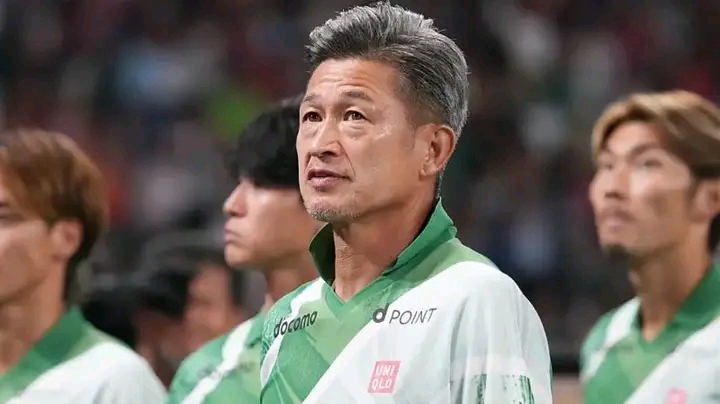
Japanese football icon Kazuyoshi Miura has added another extraordinary chapter to one of the longest careers in professional football history, scoring at the age of 59 as Fukushima United defeated Iwaki Furukawa 7-0 to progress in the Emperor’s Cup.
Miura, widely known by his enduring nickname “King Kazu,” found the net in the 52nd minute on Saturday, July 25, 2026, converting a teammate’s cutback with a first-time finish to give Fukushima United a 5-0 lead. The goal was his first in competitive football in nearly four years and came at the age of 59 years and 149 days.
The remarkable moment immediately attracted attention across the football world, not only because of the emphatic scoreline but also because of the extraordinary longevity of a player who began his professional career in the 1980s and is now preparing for another season in the professional game.
According to reports carried by Reuters and published by outlets including The Guardian, Al Jazeera and the South China Morning Post, Miura’s latest goal came after a trademark run into the penalty area before he met the cross with a composed first-time finish. His Fukushima United teammates and substitutes celebrated the goal enthusiastically, reflecting the significance of the moment for a footballer whose career has become almost synonymous with endurance and commitment to the sport.
Miura was substituted only three minutes after scoring, but by then he had already secured another place in football history.
A goal four years in the making
The Fukushima United strike ended a lengthy wait for Miura’s next competitive goal.
His previous competitive goal came in November 2022, when he scored for Suzuka PG, now known as Atletico Suzuka, in a Japan Football League match against FC Osaka. Since then, the veteran forward had continued his professional journey despite moving deeper into an age bracket at which most elite footballers have been retired for decades.
The latest goal therefore represented more than a statistic. It marked the return of an iconic player to the scoresheet at an age that would be considered extraordinary even for a former professional athlete.
Miura’s goal was also part of a dominant performance by Fukushima United. The third-tier Japanese club overwhelmed Iwaki Furukawa 7-0 in the Emperor’s Cup, with Miura’s contribution coming as the team’s fifth goal of the match.
The result ensured Fukushima United advanced in the competition, while Miura’s appearance provided an additional layer of historical significance to an already emphatic victory.
For a player who has spent much of his career under the global spotlight, the occasion demonstrated that his influence remains capable of extending beyond the traditional boundaries of age and athletic longevity.
The enduring story of ‘King Kazu’
Kazuyoshi Miura’s professional career began in 1986 with Brazilian club Santos, following his decision as a teenager to pursue football in Brazil. That move proved to be the foundation of a career that would eventually span several countries and multiple generations of football.
His career has included spells in Brazil, Japan, Italy, Croatia, Australia and Portugal. He became one of the leading figures in the development and popularisation of professional football in Japan and emerged as one of the country’s most recognisable sporting personalities.
Miura was a central figure in Japanese football during the early years of the professional J.League era. He was named the league’s Most Valuable Player in the inaugural 1993 season, a recognition that reflected his importance during a formative period in the country’s football history.
His international career with Japan was also significant. Miura scored 55 goals in 89 appearances for the Japanese national team before ending his international career in 2000. Despite his achievements, he was famously left out of Japan’s squad for the 1998 FIFA World Cup, an omission that remains one of the more discussed episodes in his international career.
Over the decades, Miura’s reputation evolved beyond his performances on the pitch. He became an enduring symbol of professionalism, discipline and personal ambition, particularly in a sport where players are generally expected to retire in their 30s.
His continued presence in professional football has consequently attracted interest well beyond Japan.
The Associated Press previously described Miura as the world’s oldest professional footballer and highlighted his extraordinary career across several countries. The report noted that he had become a prominent figure in Japanese football while continuing to compete professionally long after most of his contemporaries had retired.
From Yokohama FC to Fukushima United
Miura’s move to Fukushima United has provided another stage for the veteran forward to continue his career.
He joined the third-tier club on loan from Yokohama FC in December 2025, returning to Japan’s top three professional divisions after spending time with lower-tier side Atletico Suzuka.
His arrival at Fukushima United generated considerable interest because of his reputation and age, but the veteran forward has repeatedly maintained his desire to remain involved in professional football.
Reuters reported in June 2026 that Miura had extended his loan spell with Fukushima United until June 2027. The extension means he is set to continue his career into another season, potentially reaching his 42nd as a professional footballer.
Before his latest goal, Miura had made six appearances for Fukushima United during the club’s shortened 2026 campaign. His continued involvement has placed him at the centre of a broader conversation about longevity, athletic preparation and the changing expectations surrounding the careers of professional footballers.
His presence also carries commercial and cultural value for the club. Miura remains an enormous draw for supporters in Japan and internationally, with his appearances attracting attention from fans who have followed his career for decades as well as younger audiences discovering his story through social media and international sports coverage.
That combination of sporting experience and public interest has made Miura an unusual figure in modern football.
More than a sporting curiosity
It would be easy to frame Miura’s achievement simply as an unusual age-related record. However, the significance of his career extends beyond the novelty of a 59-year-old scoring in a competitive match.
Professional football is an intensely demanding sport. Players must cope with high-speed movement, physical contact, tactical pressure and rigorous training schedules. The fact that Miura continues to participate at a professional level therefore raises broader questions about how footballers can extend their careers and how clubs manage experienced players.
Miura’s continued career does not mean that age-related physical decline disappears. Rather, his story illustrates how professional experience, technical ability, conditioning and tactical intelligence can potentially help an elite athlete remain competitive well beyond conventional retirement ages.
His latest goal was especially notable because it came from movement inside the penalty area rather than simply from a set piece or a fortunate deflection. Reports described a run into the box followed by a first-time finish from a teammate’s cutback. The sequence demonstrated the instincts that have defined Miura’s career: timing, positioning and an understanding of where opportunities are likely to develop.
The goal may not have carried the same competitive consequences as a decisive strike in a major international final, but its historical significance was considerable.
At 59, Miura continues to demonstrate an ability to contribute on the pitch while simultaneously serving as a living link between different eras of Japanese and global football.
A career that connects generations
One of the most remarkable elements of Miura’s story is the number of football generations his career has crossed.
When he began playing professionally in 1986, the modern global football economy was vastly different from what exists today. The internet had not yet transformed sports media. Social media did not exist. The J.League had not yet been established, and Asian football was still developing its place within the international game.
Miura would go on to become part of the generation that helped establish Japanese professional football as a significant sporting institution.
Today, he continues to play in an environment shaped by global broadcasting, digital media, sophisticated sports science and increasingly internationalised football markets.
That longevity gives Miura a unique perspective on the evolution of the sport.
His career has also demonstrated the international nature of football. His early development in Brazil exposed him to a football culture that was significantly different from Japan’s. His later career included experiences in European football, including Italy and Croatia, as well as time in Australia and Portugal.
His journey therefore mirrors, in some ways, the increasingly global movement of football talent.
For African football audiences, Miura’s story also offers a useful point of reflection. Across Africa, football remains one of the continent’s most powerful cultural and economic forces, producing players who often move from domestic leagues into major European competitions. The Japanese icon’s career highlights the importance of sustained professional structures, player development and the ability of football institutions to create pathways that can support athletes across different stages of their careers.
While the circumstances of Japanese and African football are different, the underlying principle remains relevant: the development of a football ecosystem depends not only on producing young talent but also on building institutions capable of sustaining careers, preserving experience and engaging multiple generations of supporters.
Preparing for a 42nd professional season
Miura’s latest achievement comes as he prepares to continue his professional career into another season.
Reuters reported that his loan extension with Fukushima United through June 2027 will allow him to remain with the club as Japanese professional football undergoes a significant calendar transition. The country’s professional leagues are moving from a spring-to-autumn schedule toward an autumn-to-spring calendar, meaning Miura could enter his 60s while still officially active as a professional player.
The transition adds another unusual dimension to his already remarkable career.
Miura has previously indicated that he wants to continue playing until he reaches the age of 60. His latest goal, therefore, arrives at a moment when his stated personal ambition is drawing closer to reality.
However, it would be premature to assume that the goal alone guarantees a long-term role in every match. Professional football remains competitive, and playing opportunities depend on fitness, tactical decisions, squad needs and the judgment of coaching staff.
What can be established is that Miura remains professionally active and continues to participate in competitive football.
His latest appearance and goal have now provided another memorable moment in a career that has already broken conventional boundaries.
Fukushima United’s victory puts the spotlight on Miura
The 7-0 result itself deserves recognition. Fukushima United’s comprehensive victory over Iwaki Furukawa demonstrated the team’s dominance and secured progress in the Emperor’s Cup.
Yet the match will likely be remembered internationally for Miura’s contribution.
The veteran forward’s goal arrived when Fukushima were already in control, meaning his strike did not serve as a match-saving intervention or a decisive winner. That distinction is important when assessing the achievement objectively.
Nevertheless, scoring in a competitive match at 59 remains an extraordinary feat.
The context also matters. Miura’s goal was his first competitive strike in almost four years, and it came during a season in which he is preparing to continue his career at a time when most footballers of his generation have long since left the professional game.
His story therefore sits at the intersection of sporting achievement, personal discipline and cultural legacy.
The next chapter for ‘King Kazu’
The attention surrounding Kazuyoshi Miura is unlikely to disappear after one goal.
If anything, his latest performance has reinforced the global fascination with his career. The football world will continue to follow his progress as he approaches his 60th birthday and prepares for another season with Fukushima United.
Whether he scores again, starts regularly or contributes primarily through experience and leadership will depend on circumstances beyond the control of any individual player.
What is already clear, however, is that Miura has achieved something rare: he has maintained a professional football career across four decades and into a fifth, becoming an enduring figure in the history of the sport.
His latest goal should therefore be understood neither as a publicity stunt nor as proof that age no longer matters in professional sport. Instead, it is another measurable achievement in a career defined by exceptional longevity.
At 59 years and 149 days, Kazuyoshi Miura ran into the box, met a cutback and finished first time.
For a few seconds, the numbers disappeared.
There was simply a footballer doing what he has done throughout his life: finding space, reading the moment and putting the ball in the net.
That he did so nearly four decades after beginning his professional journey is what makes the moment extraordinary.
For Fukushima United, it was part of a commanding 7-0 victory.
For Japanese football, it was another landmark in the career of one of its greatest icons.
And for the wider football world, it was a reminder that some sporting stories continue to evolve long after conventional expectations say they should have ended.
Kazuyoshi Miura’s career is not yet finished. And if his latest goal is any indication, “King Kazu” still has another chapter to write.
Sources
- Reuters report on Kazuyoshi Miura’s goal for Fukushima United and the club’s 7-0 Emperor’s Cup victory, republished by The Guardian.
- Reuters report published by Al Jazeera on Miura’s first competitive goal in nearly four years and his continued professional career.
- Reuters report published by the South China Morning Post detailing Miura’s 52nd-minute goal and Fukushima United’s victory.
- Reuters report on Miura’s extension with Fukushima United through June 2027.
- Associated Press background report on Miura’s career, longevity and status in Japanese football.
Japanese football legend Kazuyoshi Miura, 59, scores his first competitive goal in nearly four years as Fukushima United thrash Iwaki Furukawa 7-0 in the Emperor’s Cup.