



Nigeria’s healthcare system is at a crossroads, with the country struggling to make meaningful progress towards achieving universal health coverage despite having sufficient research evidence to inform reforms. This is according to Prof. Chima Onoka, a Professor of Public Health and Health Systems Economics at the University of Nigeria, who delivered the 241st Inaugural Lecture of the university.
Onoka emphasized that research alone cannot transform Nigeria’s healthcare system without effective policy implementation and political engagement. He stressed that the country needs professionals who combine academic expertise with practical policy, advocacy, and implementation skills – individuals he described as “pracademics.”
“Nigeria’s healthcare reforms require professionals who can bridge the gap between research and policy,” Onoka said. “We have enough research evidence, but the challenge lies in implementing these findings and navigating the complex web of politics and bureaucracy.”
According to Onoka, progress toward Universal Health Coverage has been slow due to political interests, bureaucracy, and poor policy execution. He described universal health coverage as “a power problem,” stressing that many reforms threaten entrenched interests controlling public resources and healthcare financing.
One of the major challenges facing Nigeria’s healthcare system is the heavy dependence on out-of-pocket healthcare spending. Citizens fund about 72 per cent of healthcare costs directly, which is unsustainable and pushes many into poverty.
Onoka estimated Nigeria’s healthcare financing gap at between ₦157 trillion and ₦236 trillion over the next decade. However, he noted that improved efficiency and better resource allocation could reduce the burden.
The professor commended reforms by the National Health Insurance Authority and praised the Basic Healthcare Provision Fund for expanding access to healthcare services. He warned that without stronger financial protection mechanisms, Nigeria’s healthcare system would continue to push citizens into poverty.
“Bridging the divide between research and policy is crucial if we are to achieve universal health coverage,” Onoka said. “We need pracademics who can navigate the complex web of politics and bureaucracy to drive meaningful change.”
The Deputy Vice-Chancellor of the University of Nigeria, Josaphat Onwumere, described the lecture as intellectually enriching and practically relevant. He emphasized the importance of Onoka’s message, highlighting the need for professionals who can bridge the gap between research and policy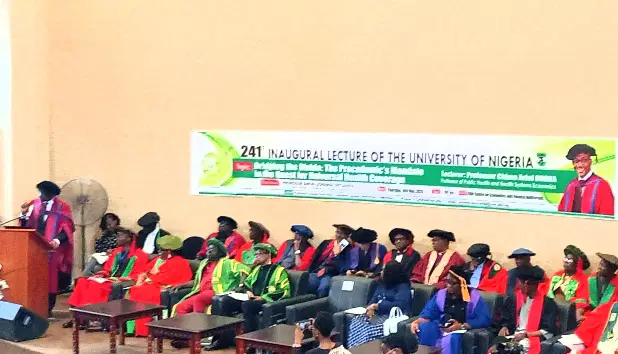
As Nigeria strives to achieve universal health coverage, Onoka’s message is clear: research alone is not enough. Effective policy implementation, political engagement, and professionals with practical skills are essential to driving meaningful change in the country’s healthcare system.
The challenges facing Nigeria’s healthcare system are complex, but Onoka’s lecture offers a roadmap for reform. By bridging the divide between research and policy, Nigeria can make progress towards achieving universal health coverage and improving the health outcomes of its citizens.