


CAS Promises Verdict Within Days as Fight for African Football’s Biggest Prize Intensifies.
The long running dispute over the Africa Cup of Nations (AFCON) title between Senegal and Morocco has entered a decisive phase, with the Court of Arbitration for Sport (CAS) promising to deliver its ruling within days following a hearing on Senegal’s appeal against the controversial decision that stripped the country of its championship.
The hearing took place on Thursday, October 8, 2026, at the sports tribunal’s headquarters in Lausanne, Switzerland. The case centres on the Confederation of African Football’s (CAF) decision to overturn Senegal’s victory in the January 18 final and subsequently declare Morocco the tournament’s champions.
According to reports by Reuters, Al Jazeera and the Associated Press, CAS Director General Matthieu Reeb said the court intended to issue a reasoned decision as soon as possible following the hearing. However, he did not announce a specific date for the verdict.
The ruling could determine whether Senegal regains the title it celebrated winning on the pitch or Morocco retains the championship awarded to it by CAF’s appeals process.
How the AFCON Final Dispute Began
The controversy dates back to the AFCON final played in Rabat, Morocco, on January 18, 2026, when Senegal faced the host nation in a tense encounter.
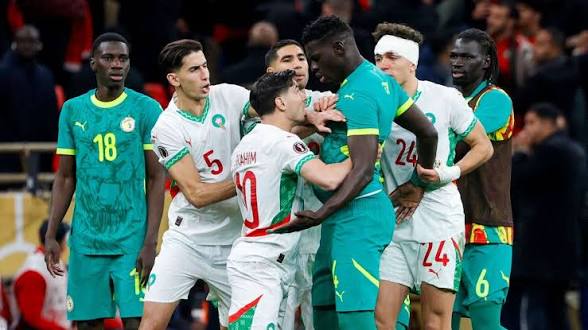
Senegal initially secured a 1–0 victory after extra time, with Pape Gueye scoring the decisive goal. However, the match was overshadowed by a major dispute late in regulation time after the referee awarded Morocco a penalty.
Senegalese players protested the decision, with several leaving the pitch and some heading towards the dressing room. Play was interrupted for approximately 14 to 17 minutes before the players returned to continue the match.
Morocco’s Brahim Diaz subsequently failed to convert the penalty, and the match proceeded into extra time, where Senegal scored the winning goal.
Although Senegal celebrated what appeared to be its second AFCON championship, following its maiden triumph in 2021, the result was later overturned by CAF.
Why CAF Awarded the Title to Morocco
On March 17, 2026, CAF’s Appeals Board ruled that Senegal had forfeited the final because of the team’s conduct during the interruption.
The decision invoked Articles 82 and 84 of the AFCON competition regulations, which address circumstances in which a team leaves the field without the referee’s authorisation and the consequences of such conduct.
CAF subsequently recorded the match as a 3–0 victory for Morocco, effectively stripping Senegal of the title and recognizing the host nation as champion.
The decision triggered widespread debate about the enforcement of competition regulations, the authority of football’s governing bodies and the relationship between disciplinary procedures and results achieved on the pitch.
Morocco’s football federation maintained that its appeal sought the application of the tournament’s rules, rather than an attempt to undermine Senegal’s performance.
Senegal, however, strongly contested CAF’s ruling, describing it as unjust and challenging the decision through the international sports arbitration system.
Senegal Takes the Fight to the Court of Arbitration for Sport
The Senegalese Football Federation formally lodged its appeal with CAS on March 25, 2026, seeking to overturn CAF’s decision and have Senegal reinstated as the tournament’s rightful winner.
CAS, an independent body responsible for resolving disputes in sport, registered the appeal against both CAF and the Royal Moroccan Football Federation.
The case was heard behind closed doors in Lausanne on October 8, with the proceedings lasting more than five hours, according to reports by the Associated Press and Agence France Presse.
Senegal’s appeal places the legality of CAF’s decision at the centre of the proceedings. The arbitration panel must examine the arguments presented by the parties and assess the relevant competition regulations and the circumstances surrounding the final.
CAS has indicated that it will issue a reasoned ruling as soon as possible following the hearing. Nevertheless, the precise timing and outcome remain uncertain until the court formally announces its decision.
The court’s ruling will be particularly significant because the dispute concerns not merely disciplinary sanctions but also the official outcome of one of African football’s most important competitions.
What the Verdict Could Mean for Senegal and Morocco
The impending decision carries considerable sporting and institutional implications for both countries.
If CAS upholds Senegal’s appeal, the CAF decision could be overturned, potentially restoring Senegal’s original victory and forcing the relevant football authorities to implement the consequences of the ruling.
If the court rejects the appeal, Morocco’s status as the officially recognized AFCON champion would remain intact under the challenged CAF decision.
A ruling could also clarify how competition regulations should be interpreted when players leave the field during a match in protest against a refereeing decision.
For Senegal, the case represents an effort to recover a title the national team initially won through its performance in the final. For Morocco, it concerns the defence of a championship officially awarded by CAF following its appeals process.
Neither outcome should be treated as certain before the court publishes its decision.
A Defining Moment for African Football Governance
Beyond the two national teams, the dispute has become an important test of confidence in African football administration.
CAF’s handling of the case has attracted scrutiny from football stakeholders and prompted questions about disciplinary consistency, procedural fairness and the credibility of decisions made after major international matches.
The controversy also highlights the importance of transparent regulations and independent dispute-resolution mechanisms in protecting the integrity of competitions across the continent.
For African football, the central issue extends beyond which country ultimately holds the AFCON trophy. It also concerns whether disciplinary rules are applied consistently, whether national federations have confidence in established appeals procedures and whether sporting disputes can be resolved through credible and transparent institutions.
CAS’s forthcoming ruling is therefore expected to attract considerable attention from supporters, administrators and legal observers across Africa and beyond.
Until the decision is announced, the AFCON title dispute remains unresolved, leaving Senegal’s appeal and Morocco’s championship status at the centre of one of the most contentious episodes in recent African football history.