
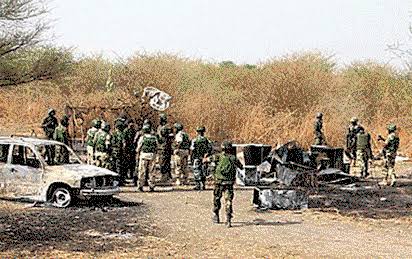
Eight Nigerian Soldiers Killed as ISWAP Landmine Blast Hits Army Patrol in Borno.
Eight Nigerian soldiers have been killed after an army patrol vehicle struck a landmine in Kinuba village, near Gamboru, in Borno State, close to Nigeria’s border with Cameroon.
The explosion occurred on Saturday, October 17, 2026, as troops accompanied members of an anti jihadist militia conducting vegetation clearing operations along a highway in the area, according to defence sources cited by Agence France Presse (AFP).
The soldiers were reportedly inspecting the militia members involved in clearing thick vegetation along the highway when their vehicle ran over the explosive device, triggering a blast that killed all eight personnel on board.
The incident was reported on Sunday, October 18, amid renewed concerns over the security situation in Nigeria’s North East, where armed groups continue to target military personnel and civilians.
ISWAP Suspected in Deadly Landmine Attack
Defence sources attributed the attack to the Islamic State West Africa Province (ISWAP), an armed extremist group operating in the Lake Chad Basin.
Ibrahim Liman, a member of an anti jihadist militia supporting military operations, reportedly confirmed the death toll and said the explosive had been planted on the dusty road and detonated remotely.
A militia member supervising the vegetation clearing operation sustained shrapnel injuries in the explosion, according to the account.
The use of roadside explosives has become a persistent security threat in parts of Borno State, where insurgents exploit thick vegetation and difficult terrain to target military patrols and other vehicles.
ISWAP and its rival, Boko Haram, have both employed improvised explosive devices and other tactics against security forces during the prolonged insurgency in Nigeria’s North East.
Attack Follows Deadly Assault on Military Base
The landmine explosion occurred on the same day Chief of Army Staff Lieutenant General Waidi Shaibu visited Maiduguri, the Borno State capital, following an earlier attack on a military base.
That separate assault reportedly left 15 soldiers and five members of an anti jihadist militia dead, highlighting the continuing dangers confronting security personnel operating in the region.
The latest incidents underscore the challenges facing Nigerian security forces as they attempt to prevent insurgents from regrouping and launching further attacks against military installations, patrols and civilian communities.
Borno State has remained at the centre of Nigeria’s insurgency since Boko Haram launched its campaign of violence in 2009. The emergence of ISWAP as a major armed faction has further complicated efforts to restore lasting security across the region.
Nigeria’s North East Faces Continuing Security Challenges
The insurgency has caused widespread loss of life and displaced millions of people across Nigeria’s North-East over the years.
Violence has also affected neighbouring countries, including Niger, Chad and Cameroon, prompting regional cooperation and joint military operations to counter armed groups operating around the Lake Chad Basin.
Although Nigerian forces have conducted sustained operations against insurgents, attacks involving roadside bombs, ambushes and assaults on military positions continue to threaten security personnel and local residents.
The latest landmine incident also highlights the risks faced by troops operating alongside local militia members during patrols and clearance operations.
For communities in Borno and surrounding areas, the continued threat of explosives along major routes raises concerns about civilian movement, commercial transportation and access to essential services.
As the security situation evolves, the deaths of the eight soldiers represent another setback in the prolonged campaign against insurgency in Nigeria’s North East.