



In Gnaoua, music is not just sound. It is smell, movement, color, and spirit. For centuries, this Moroccan spiritual tradition descended from enslaved West Africans has used all-night ceremonies called _lilas_ to heal, to remember, and to call on the _mluk_ — the spirits that move through people when the rhythm is right.
Faouzia Belkani knows this intimately. She fell into her first _jadba_, or trance, at age ten.
“It was the color red,” she tells OkayAfrica. “I moved into a different state. I fell into a trance, and I was not the same person. Something happened to me when I smelled that incense and heard that rhythm. From that time until now, I can’t resist when I hear that song, and I smell the incense.”
A neighbor was hosting a _lila_ in Marrakech. Faouzia had only meant to peek before school. Instead, the drums, the _qraqeb_ metal castanets, and the smoke pulled her into another state of being. She has been part of the ceremony ever since
Faouzia grew up in a Gnaoua family. Her father, Brahim Belkani, is a _maâlem_ — a master musician and spiritual leader. But he was not born into it. In the early 1950s, as a child in Marrakech, he sought out Gnaoua elders and followed them everywhere to learn.
“Like all Gnaoua, his first attraction was the guembri,” Faouzia says. The guembri is a three-stringed bass lute. In the ceremony it is the spiritual center, played only by the _maâlem_. He is supported by the _Koyo_, the chorus, who play _qraqeb_. The _tbel_, a large double-headed drum, announces the beginning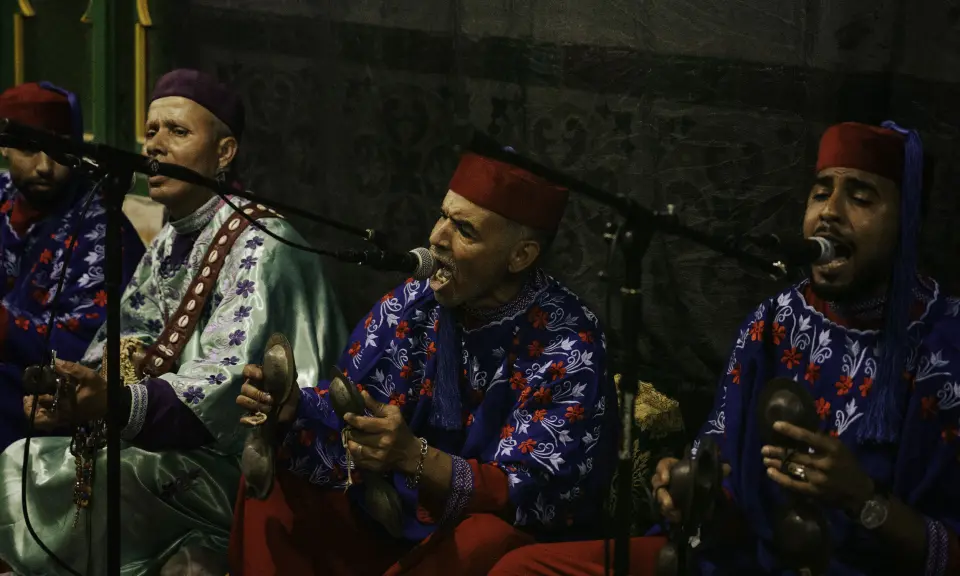
“My father didn’t touch the guembri before mastering the rhythm, memorizing the repertoire and understanding all the ethical disciplines of the tradition,” Faouzia explains. “Growing up as his daughter, I understood that Gnaoua is not something that we study, but a way of life that we transmit from generation to generation through observation and respect.”
After a decade as an apprentice, Brahim began playing the guembri in secret, waiting for his teacher to invite him. “Becoming a _maâlem_ was not only about musical ability, but about respect for and faith in the values of Gnaoua,” Faouzia says
It runs from sundown to sunrise and follows a precise spiritual order. Three elements must align: music, incense, and color. When they do, the _maâlem_ can call the _mluk_. Those spirits enter attendees, who fall into trance as part of a healing process.
The _maâlem_ holds serious responsibility. “If they make a slight mistake with the guembri, they disturb the equilibrium and the entranced will feel discomfort,” Faouzia says.
The night begins with _Awlad Bambara_, a festive, secular section of singing and dancing by the _Koyo_. This is what most people see at Gnaoua music festivals. Then the ceremony shifts into the _Niqsha_, and into _Ftouh Ar-Rahba_, the opening, when the _maâlem_ uses the guembri to call the spirits.
“This is a very serious part,” Faouzia says. “Before you can laugh and sing, but from this point onwards the ceremony follows the traditional order of color and their corresponding musical repertoires.
In Gnaoua cosmology, color is not decoration. Each of the seven colors represents a group of saints, calls specific _mluk_, and has its own elemental function. The sequence matters.
*White, or _Shorafa*_, is peace and holiness. It refers to noble descendants of the Prophet Mohammad and includes figures like Sidna Bilal, the first muezzin in Islam and patron saint of the Gnaoua. “This is the part that shows the impact of Islam on Gnaoua,” Faouzia notes.
and warrior energy. It demands respect and works with strong spirits like Sidi Hamou. This was the color that first pulled Faouzia into trance.
represents the forest, the earth, and the underworld. It is intense and physical, and often enters men.
The ceremony closes with a *multi-color phase* of fast dancing, calling on the joyful energies of Lalla Mira and Sidi Moussa.
While Gnaoua musicians are famous for bright, colorful robes, they do not need to wear the color of the spirit they are calling. What matters is the person in trance. Traditionally, the _muqaddima_ the woman who conducts the healing — provides entranced people with _jellabas_ in the correct color.
“There’s an important triangle between the _maâlem_, the _muqaddima_ and the person falling into trance,” Faouzia says. “A lot of musicians in the young generation are concerned with creating a good show, but they don’t understand what happens in the background. It’s important to preserve the roots and the secret of Gnaoua.
After high school, Faouzia studied socio-linguistics at university and researched transcendent music among Gnaoua in Marrakech. She wanted to understand her own experiences.
“I really wanted to understand why I’d been falling into trance all these years. It’s always a specific time with this specific color and smell,” she says. “I found that there’s some supernatural power going on. Something that goes beyond your nature as a normal person. And when you come back to yourself, you feel light and good.”
That feeling of lightness is the point. The _lila_ is therapy, history, and community all at once. It carries the memory of West African ancestors who were brought to Morocco, and it transforms that memory into rhythm and ritual.
Music the world can hear, secrets it cannot
Today, Gnaoua music is known globally thanks to festivals like the Gnaoua and World Music Festival in Essaouira. Thousands attend the concerts and parades. But Faouzia is careful to distinguish performance from practice.
“The Gnaoua and World Music Festival offers attendees an experience of Gnaoua music, but it does not show them the wider picture of colors and incense in the background,” she says. “It does not convey the sacred essence of Gnaoua as a lifestyle.”
For her, the music on stage is only one layer. The real work happens in the _lila_, in the dark, with the right smell in the air and the right color on your shoulders, when the guembri starts and the spirits answer.
That is when healing happens. That is when, as Faouzia did at ten years old, you are no longer the same person.