



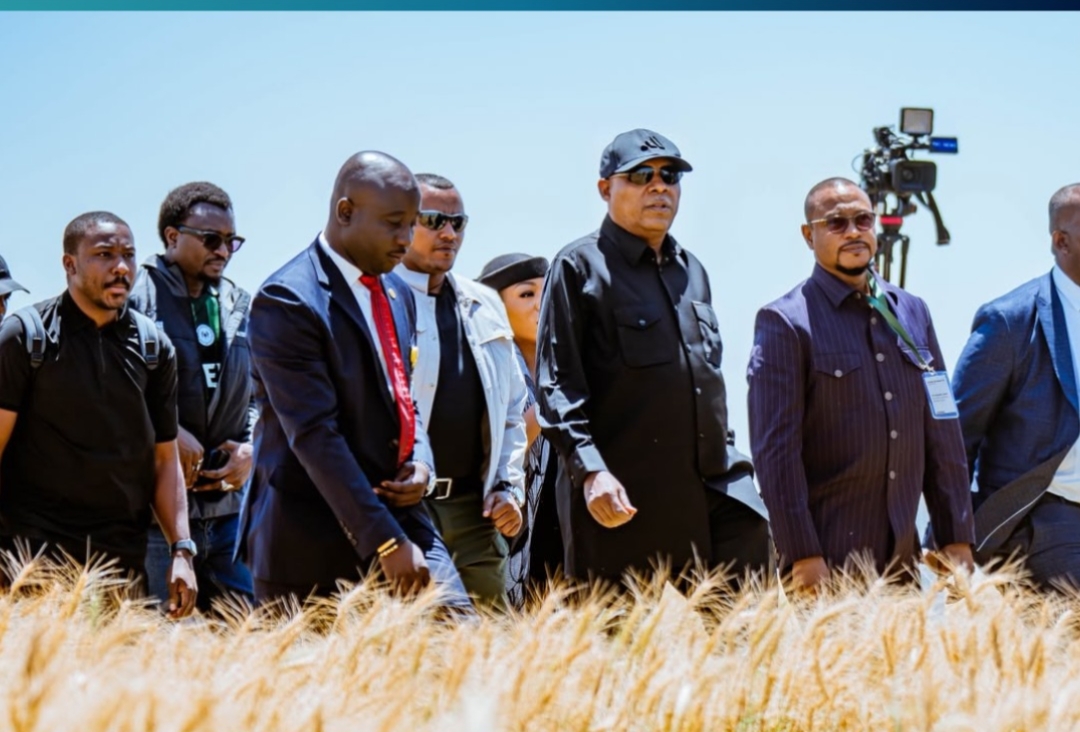
Nigeria is seeking to transform its agricultural sector through major infrastructure investments, mechanised farming and modern agricultural practices, with Vice President Kashim Shettima identifying Ethiopia’s Oromia region as a model for strengthening food production and reducing dependence on imported food.
Shettima made the remarks while leading a Nigerian delegation on a tour of farms and agricultural facilities in Oromia during the Ethiopia–Nigeria Leadership Exchange. The visit focused on sharing experiences in agricultural development, food security and nutrition.
According to the Federal Ministry of Information and National Orientation, the Nigerian government intends to address critical supply-chain gaps and logistical challenges that limit agricultural productivity, increase business costs and discourage investment in agribusiness.
The proposed approach aims to position agriculture as a major contributor to Nigeria’s economic growth while improving food and nutrition security.
During the visit, Shettima highlighted Ethiopia’s reported progress in wheat production, noting that the country had moved from substantial wheat imports towards domestic self-sufficiency and exports to neighbouring countries, including Djibouti and Kenya.
He also pointed to Ethiopia’s progress in rice production as an example of how sustained agricultural development could reduce reliance on foreign food supplies.
The Vice President said Nigeria intended to learn from Ethiopia’s experience by expanding mechanisation, adopting improved seed varieties and promoting climate-smart agricultural practices.
“We intend to embrace improved seeds, mechanisation, and climate-smart agriculture,” Shettima said.
The approach reflects Nigeria’s broader ambition to increase domestic food production, strengthen agricultural value chains and create opportunities for farmers, processors, transport operators and other participants in the agrifood industry.
However, translating Ethiopia’s experience into measurable gains in Nigeria will require sustained investment, effective implementation and policies that address the country’s specific agricultural challenges.
Shettima warned that excessive dependence on imported food could undermine national sovereignty, arguing that countries must strengthen their domestic production capacity to protect their economic independence.
He maintained that African countries should develop agricultural systems capable of meeting local demand while generating sufficient surpluses for regional and international markets.
“Africa must learn to feed itself. Ethiopia is doing it and Nigeria is on course to do the same,” the Vice President said.
His remarks underscore the importance of food security across Africa, where agricultural productivity, access to modern farming equipment, climate pressures, transportation costs and post-harvest losses remain important considerations for food systems.
For Nigeria, the challenge extends beyond increasing harvests. Reliable storage facilities, processing infrastructure, affordable agricultural inputs, rural roads and access to markets are also essential to reducing food losses and ensuring that locally produced food reaches consumers at affordable prices.
A successful infrastructure programme would therefore need to connect farmers to processing centres, distribution networks and domestic and international markets.
During the engagement, Oromia Regional State President Shimelis Abdisa outlined Ethiopia’s agricultural achievements, highlighting the diversity of crops produced across the country and the expansion of agricultural exports.
According to the Federal Ministry of Information and National Orientation, Abdisa said Ethiopia cultivated more than 200 crop varieties and had expanded exports of agricultural commodities, including bananas, avocados and coffee.
He also highlighted wheat production as a significant contributor to the country’s economy and disclosed collaboration with the Dangote Group on fertiliser production for farmers in the region.
The delegation visited wheat, banana and papaya farms to observe agricultural production systems and initiatives aimed at expanding output.
These activities provided Nigerian officials with an opportunity to examine Ethiopia’s approach to agricultural development and identify practices that could inform future policies at home.
Nevertheless, the effectiveness of any adaptation will depend on Nigeria’s own conditions, including land availability, regional differences in climate, security challenges, access to finance and the needs of smallholder farmers.
Nigeria’s proposed agricultural infrastructure drive comes amid continuing efforts to reduce food-import dependence, improve domestic production and make farming more commercially viable.
The government’s stated priorities include modern farming methods, improved seeds, climate-smart agriculture and measures to address supply-chain constraints.
Shettima also announced plans for a nationwide tree-planting campaign targeting 20 billion trees during the next rainy season, drawing inspiration from Ethiopia’s Green Legacy Initiative. The proposed campaign is intended to support environmental restoration, although its implementation will require substantial planning, resources and public participation.
For Nigeria, the wider challenge will be converting these announcements into practical improvements that farmers and consumers can experience. Increased agricultural output must be accompanied by stronger market access, improved rural infrastructure, predictable policies and investment that benefits producers across different regions.
Closer cooperation between Nigeria and Ethiopia could provide opportunities for knowledge exchange, agricultural investment and regional food trade.
Both countries have substantial agricultural potential, but achieving food self-sufficiency and becoming reliable suppliers to international markets will depend on consistent implementation, productivity improvements and the ability to build resilient food systems.
As Africa continues to pursue economic integration and industrial development, strengthening agricultural production could play an important role in creating jobs, supporting rural livelihoods and improving food availability across the continent.
Nigeria plans to strengthen agricultural infrastructure, mechanised farming and food security as Vice President Kashim Shettima highlights Ethiopia’s Oromia model as a potential blueprint for Africa.