

Reported by Musa Antiketu,| Journalist at Obaland magazine.
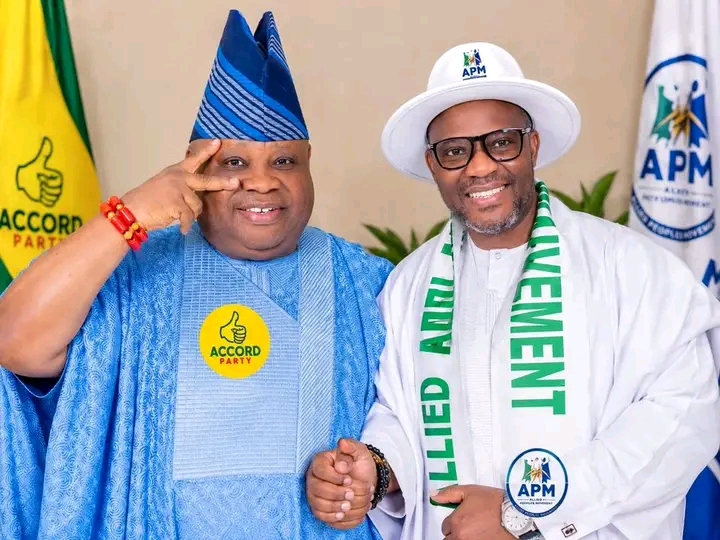
The Allied Peoples Movement (APM) governorship candidate in Osun State, Adewale Adebayo, has attributed the party’s performance in the 2026 Osun governorship election to what he described as the determination of voters to exercise their democratic choice despite political pressure.
Adebayo’s position comes against the backdrop of a closely watched contest involving the APM, the All Progressives Congress (APC), the Accord Party and the African Democratic Congress (ADC), among other political parties.
Ahead of the poll, the APM candidate had presented himself as an alternative to the established political forces in the state, urging voters to focus on governance, accountability and development rather than party structures alone.
The APM’s campaign received a notable political boost in June when former Osun State Governor, Prince Olagunsoye Oyinlola, alongside other political figures, endorsed Adebayo. The endorsement was presented as part of an alliance involving elements of the PDP and APM seeking to challenge existing political alignments in the state.
Adebayo had also repeatedly argued that the election should be about the people and their expectations from government. In an interview published by the Nigerian Tribune, he said politics should ultimately be centred on citizens rather than political parties, while describing the APM-PDP alliance as an effort to build a credible political alternative.
The 2026 Osun governorship election featured 14 political parties, according to information released by the Independent National Electoral Commission (INEC). The commission’s list included the APC and APM, while the PDP and Labour Party were absent from the final list of participating parties.
The APC entered the contest with significant organisational strength. Its campaign council described the election as a “must-win” contest and positioned the poll as an important test of the party’s readiness ahead of the 2027 general elections. The party’s candidate, Munirudeen Bola Oyebamiji, also expressed confidence that the APC would reclaim Osun State.
Against that backdrop, Adebayo’s claim that determined voters could overcome the influence of established political machinery underscores a wider question surrounding Nigerian elections: whether electoral outcomes are ultimately shaped by party structures and political heavyweights or by the independent choices of citizens at the polling units.
For Obaland magazine, such claims require distinction between political interpretation and officially established electoral facts. Candidates and political parties are entitled to assess election outcomes from their perspectives, but final claims about victory, vote margins and the integrity of the process must be anchored in results declared through the appropriate electoral authorities.
The election also attracted significant attention because of the broader political realignments taking place across the South-West. Oyinlola’s endorsement of the APM candidate, for instance, added another layer to the contest and demonstrated the fluidity of political alliances ahead of the 2027 general elections.
The election campaign was not without controversy. Reports of political violence, allegations of vote buying and clashes involving supporters of rival parties had raised concerns about the security and credibility of the electoral process before voting. The Punch reported an incident in which an Accord supporter was killed in Esa-Oke, while an APC campaign procession in Ede was involved in a fatal accident.
INEC, meanwhile, had repeatedly stressed the importance of a peaceful and credible process. The commission said it was prepared to conduct the election across Osun’s 30 local government areas, with more than two million eligible voters registered for the contest.
Adebayo’s argument therefore forms part of a larger democratic narrative in Osun: the extent to which voters can assert their political preferences independently of established party structures, endorsements and campaign machinery.
As the political dust settles, attention will remain focused on the official electoral record, voter turnout, the distribution of votes across the state and the responses of the competing political parties.
For the electorate, however, the central issue remains the same: whether the political choices made at the polling units will translate into accountable leadership, improved governance and meaningful development for the people of Osun State.
Sources
- The Punch
- Nigerian Tribune
- The Sun Nigeria
- INEC – Osun Governorship Election information
APM Osun governorship candidate Adewale Adebayo says determined voters demonstrated the power of the electorate amid a closely contested 2026 Osun governorship election.