
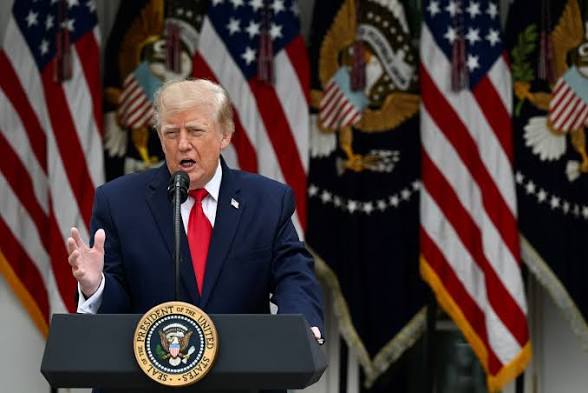
Trump Announces Nuclear Disarmament Talks With Russia and China as Global Arms Control Concerns Grow.
United States President Donald Trump has announced that Washington is holding discussions with Russia and China on nuclear disarmament, raising the prospect of renewed international efforts to curb the world’s largest nuclear arsenals.
Trump made the disclosure on Thursday, October 15, 2026, during an interview with Newsmax, saying his administration was discussing denuclearization with both Moscow and Beijing.
“The whole thing is a shame, because I’d love to denuclearise if possible,” Trump said, adding that the United States was talking to Russia and China about the issue.
According to a report by Reuters, Trump also expressed concern about China’s expanding nuclear capabilities, predicting that Beijing could catch up with the United States within the next five years. He has reportedly discussed the issue with Chinese President Xi Jinping.
However, the extent of the discussions, their specific objectives and whether they have progressed towards formal negotiations remain unclear.
New START Treaty Expiration Raises Concerns
Trump’s announcement comes amid growing concerns about the future of global nuclear arms control following the expiration of the New Strategic Arms Reduction Treaty, commonly known as New START, earlier in 2026.
Signed in 2010 by the United States and Russia, the treaty established limits on the countries’ deployed strategic nuclear warheads and delivery systems. It was extended once, in 2021, for five years under the administrations of former US President Joe Biden and Russian President Vladimir Putin.
The agreement’s expiration removed a key framework governing strategic nuclear weapons between Washington and Moscow, intensifying calls for a new arrangement to prevent an uncontrolled arms competition.
Trump has advocated a broader agreement that would include China, arguing that any future nuclear arms control framework should reflect Beijing’s growing military capabilities.
Russia, US and China Dominate Global Nuclear Arsenals
Russia, the United States and China occupy central positions in international nuclear security discussions because of the size of their arsenals and their influence over global security.
Data from the Stockholm International Peace Research Institute (SIPRI) identifies Russia as possessing the world’s largest stockpile of nuclear warheads, followed by the United States and China. The United States has more deployed warheads than Russia, according to figures cited by Reuters.
China’s nuclear arsenal has also been expanding, prompting concerns in Washington about the future balance of strategic power.
However, Beijing has previously resisted calls to participate in trilateral nuclear disarmament negotiations, arguing that its nuclear capabilities remain substantially smaller than those of the United States and Russia.
In August 2025, China’s Foreign Ministry described proposals requiring Beijing to join nuclear disarmament negotiations with Washington and Moscow as unreasonable and unrealistic, maintaining that the three countries’ nuclear capabilities and security circumstances were not comparable.
This position presents a significant obstacle to efforts to establish a comprehensive agreement involving all three powers.
Prospects for a New Nuclear Arms Control Framework
Although Trump’s latest comments suggest continued interest in nuclear disarmament, public confirmation of discussions does not necessarily mean that the countries have reached an agreement or committed to reducing their nuclear arsenals.
Any meaningful arrangement would likely require negotiations over warhead limits, verification procedures, transparency measures and compliance mechanisms. Differences over national security priorities and the balance of military power could also complicate progress.
For Russia and the United States, rebuilding confidence after the expiration of New START will be a major challenge. Bringing China into a common framework would add another layer of complexity, particularly given Beijing’s longstanding objections to negotiations based on the existing balance between the larger nuclear powers.
The international community will therefore be watching for further details about the discussions, including whether they lead to formal negotiations or concrete commitments.
For Africa and other regions outside the principal nuclear powers, progress on disarmament carries broader significance. A renewed nuclear arms race could deepen geopolitical tensions, divert resources from development priorities and increase the risks associated with international conflict.
Conversely, credible arms control agreements could strengthen international stability and reinforce global efforts to prevent nuclear proliferation.
For now, Trump’s announcement signals an expressed willingness to pursue dialogue with Moscow and Beijing. Whether that willingness translates into a verifiable and lasting reduction in nuclear weapons will depend on the positions of all three governments and their readiness to accept meaningful commitments.