


ABUJA — The Federal Government has rejected claims that it is ceding Nigeria’s solid minerals to Chinese companies, insisting that the mining sector remains open to investors from across the world under strict compliance with local laws.
Kehinde Bamigbetan, Special Adviser on Media and Strategy to the Minister of Solid Minerals Development, Dr. Dele Alake, said the allegations were false and part of a deliberate attempt to discredit the minister.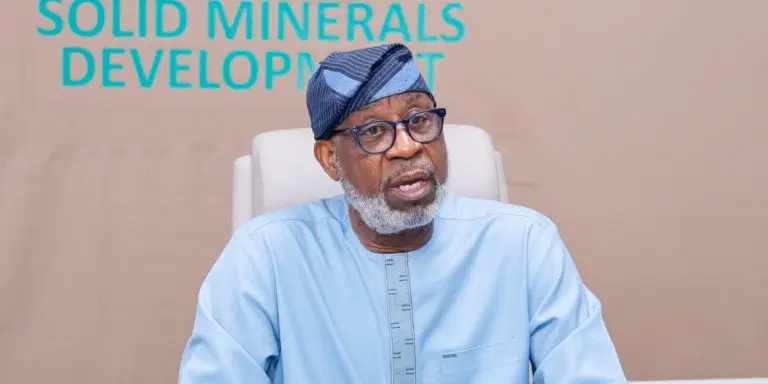
Bamigbetan was responding to a publication by Steve Kefas titled _“How Nigeria’s Mineral Wealth is Being Handed Over to the Chinese.”_ The article alleged that the Tinubu administration was favoring Chinese firms in the allocation of mining rights.
According to Bamigbetan, the controversy stems from the recent revocation of mining licences belonging to Basin Mining Limited, described as a Nigerian subsidiary of British-Australian company Jupiter.
He explained that the licences were withdrawn after the company failed to pay statutory annual service fees.
“The outstanding fees stood at N1.223 billion and later accumulated to N2.494 billion before the revocation,” he said.
Rather than settle the debt, Bamigbetan said Jupiter dragged the Federal Government to an international arbitration court. At the same time, he alleged, the company launched a media campaign to pressure the ministry into reversing its decision.
“That is where this so-called report is coming from. It is not about China. It is about a company that refused to comply with Nigerian law,” he stated.
He said since taking office, the minister has held engagements with investors from Europe, America, Canada, Australia and other regions.
“Dr. Alake has visited China only twice — once as part of President Bola Tinubu’s state visit and again to attend China Mining Week 2025 at the invitation of the Chinese government,” Bamigbetan noted.
He added that the minister has also been to the London Mines and Money conference, Mining Indaba in Cape Town, and made investment trips to Australia.
The presidential aide said the core of the current reforms is local value addition — compelling mining companies to process minerals in Nigeria instead of exporting raw ore.
Under this policy, several Chinese companies have already set up processing plants in the country. But Bamigbetan stressed that the door remains open to all compliant investors.
“Nigeria has about 44 minerals in commercial quantities. We need technology, capital and expertise. We are not going to limit ourselves to one country,” he said.
He noted that more than 300 companies from Europe, America, Canada and Australia are already active in different segments of Nigeria’s solid minerals sector.
Bamigbetan argued that foreign participation in mining did not start with the Tinubu administration.
He traced the liberalisation of the sector to the 1990s, with the establishment of the Nigerian Investment Promotion Commission and other reforms that opened the economy to foreign capital.
“What we are doing differently now is insisting on beneficiation. We don’t want to remain a country that just digs and ships out raw materials,” he said.
The aide acknowledged Nigeria’s long-standing economic ties with China in trade, infrastructure, technology and investment. He said the decision to elevate relations to a “strategic partnership” under President Tinubu has also led to increased investment commitments.
He defended collaboration with China in mining as a global reality, given the country’s dominance in processing critical minerals like lithium, cobalt and rare earths.
Bamigbetan also cited ongoing technical cooperation between the Nigeria Geological Survey Agency and the China Geological Survey Agency on geological mapping and exploration.
But he was quick to add: “That does not mean we are shutting out the West. Our policy is inclusive.”
Our goal is to reposition the sector for economic growth, job creation and revenue diversification,” he said. “We want responsible investment — whether from China, Europe, America or Nigeria.”
Bamigbetan said the ministry will not be distracted by what he called “mischievous narratives.”
“Nigeria’s minerals belong to Nigerians. Our job is to ensure they are exploited transparently, legally, and in a way that benefits our people,” he concluded.
As global demand for critical minerals rises, the Tinubu administration says it is betting on reforms, enforcement, and partnerships to make mining Nigeria’s next major economic pillar — not oil.