



Reported by Musa Antiketu,| Journalist at Obaland magazine.
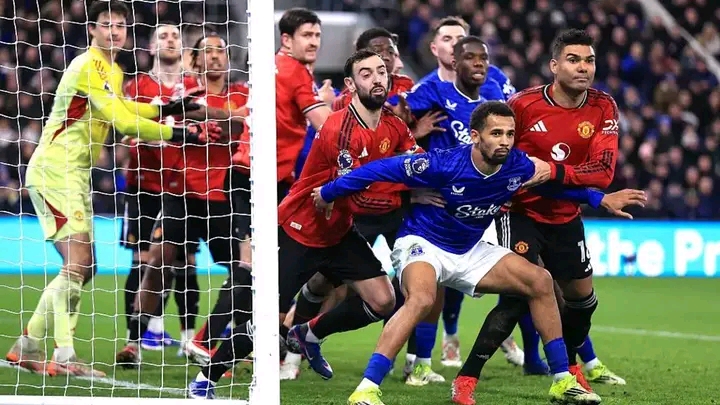
Premier League referees are expected to take a stricter approach to holding, shirt-pulling and grappling during corners and free-kicks, as officials seek to bring greater consistency to one of the most contentious aspects of set-piece defending and attacking.
The issue has attracted increasing attention in English football, with players frequently engaging in physical battles inside the penalty area before and during dead-ball situations. Referees have faced growing pressure to distinguish between legitimate physical contact and actions that unfairly restrict an opponent’s movement.
According to reporting by Sky Sports, grappling and holding have become a significant point of controversy in the Premier League, with an increase in penalties awarded for holding at set pieces. The outlet reported that seven penalties had been awarded for holding at set pieces by matchweek 28 of the 2025/26 campaign, compared with four at the same stage of the previous season.
The crackdown does not necessarily represent the introduction of an entirely new football law. Rather, it reflects a stronger emphasis on the existing laws governing holding and impeding opponents.
Under the relevant provisions of Law 12, a player can be penalised for holding an opponent or impeding an opponent through physical contact. The challenge for referees is determining when normal physical competition crosses the line into an offence.
What the tougher approach means
Officials are expected to pay closer attention to the duration and severity of holding, its effect on a player’s ability to move and whether a player uses one or both arms to restrict an opponent.
However, there is no fixed number of seconds that automatically turns a hold into a foul. Refereeing decisions remain dependent on the circumstances of each incident.
Sky Sports noted that the threshold for intervention has been a matter of referee judgement, with the aim of avoiding unnecessary VAR involvement while still addressing clear offences.
The distinction is particularly important before a corner or free-kick is taken. When the ball is not yet in play, certain physical incidents cannot result in a penalty. Referees can instead intervene through warnings or disciplinary action where appropriate. Once the ball is in play, however, holding or other offences inside the penalty area can result in a penalty kick.
The controversy has intensified as teams increasingly use crowded penalty areas and elaborate movement patterns to create advantages from set pieces. Arsenal, among other clubs, have attracted considerable attention for their effectiveness from corners, while opponents and commentators have debated whether some of the physical battles around the goalkeeper go beyond acceptable contact. The Guardian recently highlighted the wider debate surrounding grappling at corners and the difficulty of judging multiple physical incidents within the same sequence.
VAR and set-piece incidents
The debate also comes amid developments in the international interpretation of video review.
The Guardian reported that the International Football Association Board (IFAB) clarified the VAR protocol ahead of the 2026 World Cup, allowing video officials to examine certain offences committed before a set piece if the incident has a direct impact on a subsequent goal, penalty or sending-off decision. The development has been widely viewed as another attempt to address serious holding and grappling offences during set pieces.
The changes place additional emphasis on consistency. Players and coaches have increasingly sought to exploit uncertainty around what constitutes permissible contact, making clear communication between referees, players and coaching staff particularly important.
England manager Thomas Tuchel also acknowledged the issue while discussing the new approach to set-piece grappling, noting that Premier League corners and set pieces can be more physical than those in some European competitions. He stressed the importance of achieving consistency in the way the rules are applied.
For Premier League clubs, the change could have tactical consequences. Teams that rely heavily on physical screens, blocks, crowding and movement around the six-yard box may need to adjust their set-piece routines if officials consistently penalise excessive holding.
The emphasis, however, is not expected to eliminate physicality from English football. Instead, the objective is to ensure that physical contact remains within the boundaries of the laws while preventing players from gaining an unfair advantage through sustained holding or grappling.
As the new Premier League campaign progresses, consistency will remain the central test. Players, coaches and supporters will be watching closely to see whether referees apply the stricter approach uniformly across matches and clubs.
For the Premier League, the challenge is to preserve the physical character of the competition while ensuring that set pieces are decided by footballing skill rather than unchecked holding and obstruction.
Sources
Premier League referees are set to take a tougher approach to grappling, holding and shirt-pulling at corners and free-kicks, with clubs facing closer scrutiny of set-piece tactics.