


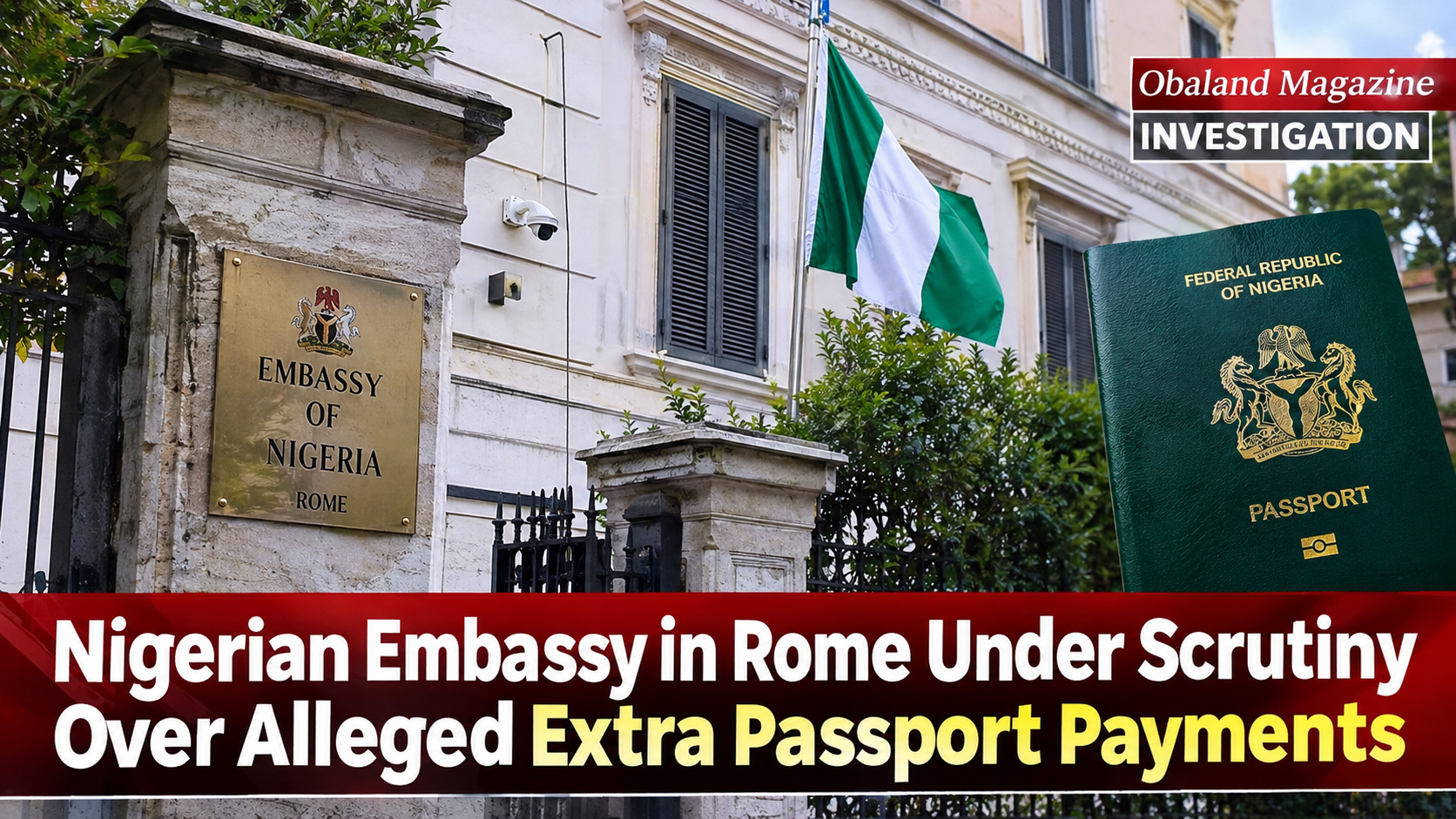
Immigration department maintains that no additional fees are required, while allegations involving unofficial intermediaries revive questions about transparency, passport processing and diplomatic accountability.
ROME, ITALY — November 4, 2026
The Nigerian Embassy in Rome is facing renewed questions over alleged unofficial payments connected to passport services, as accounts attributed to some Nigerian citizens suggest that certain individuals continue to create the impression that additional money must be paid to secure passport processing, particularly in urgent circumstances.
The allegations have revived concerns about unauthorised intermediaries, transparency in consular operations and the effectiveness of measures introduced by previous embassy administrations to protect Nigerian citizens from exploitation.
At the centre of the controversy is a fundamental contradiction: while some citizens allegedly believe that extra payments are necessary to obtain passport services, the head of the embassy’s immigration department has maintained that no additional fees are required beyond the official charges.
The situation has also prompted questions about the response of Nigeria’s newly accredited ambassador to Italy, with some citizens reportedly expressing doubts about whether the embassy’s new leadership will fully examine the allegations.
There is currently no verified evidence establishing that the ambassador or any embassy official has personally received, authorised, or benefited from the alleged payments.
Citizens’ Allegations: Who Is Demanding Additional Money?
According to concerns attributed to Nigerian citizens seeking passport services in Rome, certain individuals allegedly make applicants understand that additional payments are necessary when they arrive at the embassy.
These alleged demands are particularly troubling for citizens seeking urgent passport renewal or printing, often because of immigration documentation, employment obligations, family emergencies or international travel.
Some accounts suggest that the amounts allegedly requested have remained similar to those reportedly demanded before the current administration.
However, the identities of the individuals allegedly communicating these demands, the precise amounts involved and whether any payments were actually made in 2026 remain matters requiring independent verification.
It has not been established whether those individuals are unauthorised agents, independent intermediaries or persons falsely claiming to have connections with embassy personnel.
These distinctions are essential. An unauthorised individual exploiting passport applicants does not automatically establish wrongdoing by the embassy or its officials.
Nevertheless, the reported concerns warrant attention because citizens should not be misled about the costs and procedures associated with obtaining official documents.
Immigration Department: No Additional Fees Required
In response to questions concerning passport processing, the head of the immigration department at the Nigerian Embassy in Rome has maintained that applicants are not required to pay additional fees beyond the officially prescribed charges.
The statement, as reported to Obaland Magazine, directly challenges suggestions that extra payments are a necessary condition for obtaining urgent passport services.
It also raises an important question: if the immigration department does not recognise additional charges, why are some applicants allegedly being led to believe that such payments are required?
The department’s position should provide reassurance to Nigerian citizens who may encounter individuals requesting money outside official payment procedures.
However, effective public communication and transparent complaint-handling mechanisms are necessary to ensure that applicants understand their rights and know where to report suspicious demands.
A Problem That Predates the Current Administration
Concerns surrounding passport processing at the Nigerian Embassy in Rome are not entirely new.
In July 2025, Obaland Magazine reported allegations that unauthorised individuals posing as embassy agents were demanding payments of up to €500 from Nigerians seeking passport-related assistance.
The publication also reported measures introduced under the leadership of then-Chargé d’Affaires Mustapha Chagwas Mohammed to improve transparency, strengthen identity verification and discourage unauthorised intermediaries.
The embassy’s stated position at the time was that applicants should rely on official payment channels and report suspicious demands.
Earlier reporting also documented concerns about passport delays and access to consular services.
These historical accounts provide relevant context, but they do not establish that the same individuals or practices remain active in 2026.
The central question is whether the safeguards introduced in previous years have been effective and whether any newly reported complaints have been formally examined.
New Ambassador, Renewed Expectations
Nigeria’s newly appointed Ambassador to Italy, Abimbola Tolulope Samuel Reuben, formally presented her Letters of Credence to Italian President Sergio Mattarella at the Quirinale Palace in Rome on September 28, 2026.
Her accreditation marks a new chapter in Nigeria’s diplomatic representation in Italy and creates an opportunity to strengthen public confidence in consular administration.
Yet the reported passport payment concerns present an early test of the mission’s commitment to transparency and responsiveness.
Some citizens allegedly question whether the new ambassador is prepared to investigate the reported practices.
There have also been unverified suggestions that financial considerations could influence how the issue is handled.
Obaland Magazine has obtained no evidence that Ambassador Reuben has a financial interest in the alleged payments, has benefited from them or has deliberately obstructed any investigation.
Such speculation cannot responsibly be presented as an established explanation for the embassy’s actions or inaction.
The more immediate and verifiable questions are whether formal complaints have reached the ambassador’s office, whether investigations have been initiated and whether the embassy has communicated the results of any inquiries.
The ambassador must also be afforded a fair opportunity to explain what steps her administration has taken or intends to take.
Embassy’s 2026 Restrictions and the Question of Enforcement
In a public notice dated July 1, 2026, the Nigerian Embassy addressed unauthorised activities around its premises, including loitering, unauthorised selling and disturbances affecting the surrounding community.
The notice introduced stricter appointment-based access and warned that Italian authorities would increase monitoring around the mission.
Obaland Magazine reported the development on October 1, 2026.
While these measures address order and security around the embassy, they do not, by themselves, demonstrate that the alleged practice of requesting unofficial passport payments has been investigated or eliminated.
The distinction matters because controlling access to embassy premises and preventing financial exploitation are related but separate responsibilities.
Questions the Embassy Must Clarify
The concerns attributed to Nigerian citizens raise several matters of legitimate public interest.
Has the embassy received formal complaints about individuals requesting additional money for passport services during 2026?
If so, how many complaints were received, and what action followed?
Does the embassy recognise any officially authorised charge for urgent passport printing beyond the standard application fees and applicable published charges?
Are applicants provided with clear information about all payable fees before attending their appointments?
What procedures exist for identifying unauthorised intermediaries and protecting citizens who report suspicious payment requests?
And, crucially, will the new ambassador support a transparent review of substantiated complaints and communicate the outcome to the Nigerian community?
Answers to these questions would help establish whether the concerns reflect misinformation, unauthorised activity by private individuals, administrative shortcomings or misconduct requiring further investigation.
Protecting Nigerians Abroad
For Nigerians living in Italy, access to a valid passport is more than a matter of convenience.
Passport documentation can be essential for residence permit renewals, employment procedures, international travel and access to other administrative services.
Applicants facing urgent deadlines may be especially vulnerable to individuals claiming that additional payments can accelerate processing.
Clear fee schedules, secure payment channels, reliable appointments and accessible complaint procedures are therefore important safeguards.
At the same time, public confidence requires fairness toward embassy personnel. Allegations should be investigated without assuming that officials are responsible simply because questionable activities are reported near a diplomatic mission.
Obaland Magazine’s Position: Accountability Must Be Evidence-Based
Obaland Magazine recognises the importance of Nigeria’s diplomatic mission in Rome and the efforts of officials working to provide essential consular services.
The publication also maintains that citizens have the right to question unexplained payment demands and seek clarification from public institutions.
The immigration department’s position that no additional fees are required is an important part of the public record.
So too are the concerns attributed to citizens who say they have been led to believe otherwise.
Neither account should be distorted.
The responsibility of investigative journalism is to examine the evidence, establish who made any alleged demands, determine whether payments occurred and provide all affected parties with an opportunity to respond.
Conclusion: An Opportunity for the New Administration
The controversy surrounding alleged additional passport payments in Rome presents an opportunity for Nigeria’s new ambassadorial administration to reinforce public trust.
A transparent explanation of official fees, an accessible system for reporting unauthorised demands and an evidence-based review of substantiated complaints would help address the uncertainty surrounding passport services.
For Nigerian citizens, the central expectation is straightforward: essential consular services should be delivered through clear, lawful and accountable procedures.
For the embassy, the challenge is to demonstrate that its systems protect applicants from misinformation and exploitation.
The question is not whether allegations alone establish corruption. They do not. The question is whether reported concerns will receive a transparent, impartial and credible response.
Obaland Magazine will continue examining the matter in the public interest, seeking documentary evidence, firsthand accounts and responses from the Nigerian Embassy in Rome and the Nigerian Immigration Service.
Obaland Magazine Investigative Desk
Independent Journalism | Public Accountability | Transparency
© 2026 Obaland Magazine. All rights reserved.