



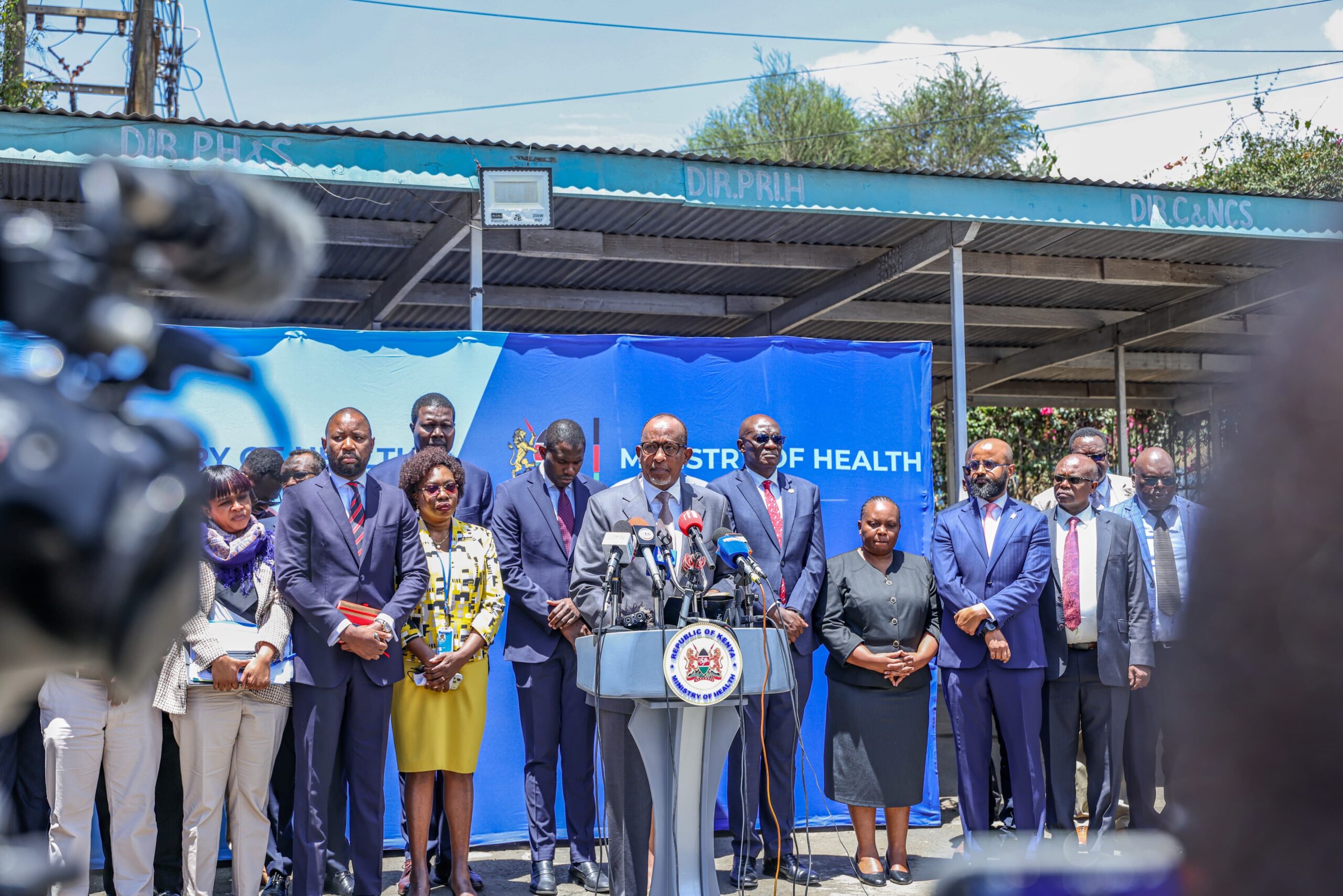
Kenya Confirms First Ebola Case as Congo Linked Outbreak Reaches Nairobi.
NAIROBI, Kenya has confirmed its first imported case of Ebola disease after a Kenyan citizen who had been living in the Democratic Republic of Congo (DRC) tested positive for the virus and later died in Nairobi.
Kenya’s Ministry of Health said the patient had been living in the DRC for seven years and became ill about a month before travelling from the DRC by road to Kampala, Uganda. He subsequently boarded Jambojet Flight 8523 and arrived at Jomo Kenyatta International Airport in Nairobi on October 3.
According to Kenyan health authorities, the patient underwent routine public health screening at the airport before being taken to a hospital in Nairobi. He was later isolated and transferred to an isolation facility after presenting symptoms including fever, chills, fatigue, muscle pain, sore throat, painful swallowing and bleeding beneath the skin at injection sites. Samples tested independently by Kenya’s National Virology Reference Laboratory and the Kenya Medical Research Institute confirmed Bundibugyo Ebola virus disease. The patient died on the night of October 5 and was buried the following day under safe and dignified burial protocols.
Kenyan authorities have begun an extensive contact tracing operation. Twenty eight contacts, including family members and healthcare workers who attended to the patient, have been identified, while officials are also seeking to trace 23 passengers and four crew members who travelled on the same flight from Uganda. People considered to have been at risk are being placed under quarantine and enhanced monitoring.
The World Health Organization (WHO) said Kenya’s health authorities are strengthening case investigation, contact listing, surveillance, screening at high-risk points of entry and public-health communication. The agency confirmed that Kenya notified WHO of the case on October 6 under the International Health Regulations. Kenya is the fourth country to confirm Bundibugyo virus disease in connection with the current outbreak, following cases reported in the DRC, Uganda and France.
The case comes as the DRC continues to confront the largest Ebola outbreak ever recorded in the country. WHO reported that, as of September 23, the DRC had recorded 7,890 confirmed cases and 3,799 deaths across 63 health zones in seven provinces. The agency has warned that continued geographical expansion and high transmission levels are increasing the risk of cross-border spread.
The outbreak involves the Bundibugyo virus, a species of Ebola for which there is currently no approved vaccine or specific treatment. WHO says control efforts depend heavily on rapid identification and isolation of cases, laboratory testing, contact tracing, supportive care, safe burials and strong community engagement.
Kenya’s Health Ministry said it had maintained heightened Ebola surveillance since the outbreak began in May. By October 6, authorities had screened more than 652,000 travellers and tested 267 samples through five laboratories. The government is working with WHO and regional partners as it seeks to prevent the imported case from developing into wider community transmission.
The development underscores the difficulty of containing infectious diseases across East Africa, where extensive cross border movement links communities in the DRC, Uganda and Kenya. While authorities have not reported additional confirmed cases in Kenya from this incident, the ongoing tracing and monitoring of exposed individuals will be critical to determining whether transmission has occurred beyond the initial patient.