


Mother and 14 Year Old Daughter Die as Residents Raise Safety Concerns in Okpoko.
A woman and her 14 year old daughter have died after a three storey building under construction collapsed onto a neighbouring residential property in Okpoko, Ogbaru Local Government Area of Anambra State, raising renewed concerns about building safety, construction standards and regulatory enforcement in Nigeria.
The victims were identified as Mrs Happiness Ugoagu and her teenage daughter, Confidence. Both were reportedly inside their residence when the adjoining structure collapsed, trapping them beneath the debris.
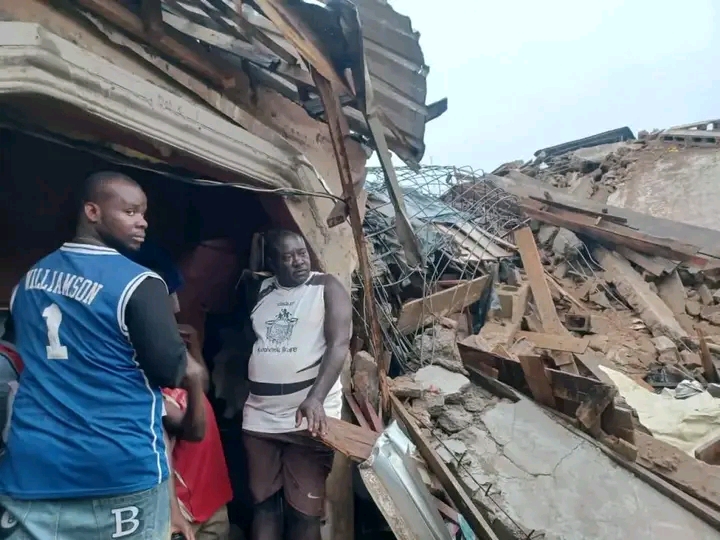
According to a report published by the Anambra State Government on October 8, 2026, the incident occurred at No. 11 Emeka Ugwuanyi Street, near Anabanaba in Okpoko, amid heavy rainfall. Emergency responders, residents and local officials mobilized to the scene to search for people trapped beneath the rubble.
The operation involved the deployment of an excavator to assist with debris removal, while the National Emergency Management Agency (NEMA) dispatched a team to support rescue efforts. The remains of the mother and daughter were subsequently recovered and evacuated to a morgue.
The incident has left the community mourning the loss of two family members and renewed questions about the safety of buildings under construction in densely populated residential areas.
Residents Raise Questions Over Construction Safety
Residents reportedly expressed concerns about the condition of the land on which the collapsed building was being constructed, alleging that the area was waterlogged and potentially unsuitable for a three-storey structure.
According to accounts published by Nigerian media outlets, residents also claimed that an engineer who initially handled the project had recommended limiting the building to two storeys because of the ground conditions.
They alleged that the recommendation was not followed and that another engineer was subsequently engaged to continue the project to three storeys.
These claims have not been independently established as the definitive cause of the collapse. Authorities had yet to determine the cause of the disaster at the time of reporting.
A formal investigation would be necessary to establish whether the collapse resulted from structural deficiencies, foundation problems, construction practices, the effects of rainfall or a combination of factors.
The findings would also help determine whether any building regulations were violated and whether negligence contributed to the deaths.
Emergency Agencies Respond as Authorities Assess the Scene
The Anambra State Emergency Management Agency (SEMA), NEMA and local emergency officials participated in the response, alongside residents and other sympathisers who gathered at the scene.
The Mayor of Ogbaru Local Government Area, Nnamdi Ifejika, supervised the rescue operation, according to the state government’s account.
Noble Igwe, the member representing Ogbaru State Constituency I in the Anambra State House of Assembly, expressed sympathy with the bereaved family over what he described as a devastating incident.
The remains of the victims were taken to a morgue after their recovery, while efforts continued to remove debris and assess the surrounding area.
Although the immediate rescue operation resulted in the recovery of the mother and daughter, the circumstances surrounding the collapse remain a matter of public concern.
Building Safety and Regulatory Enforcement Under Scrutiny
The Okpoko tragedy highlights the risks posed by unsafe construction practices, particularly in communities where residential buildings stand close to ongoing construction projects.
In Nigeria, building collapses have repeatedly raised questions about compliance with approved building plans, the quality of construction materials, professional supervision, foundation design and the enforcement of development regulations.
Where buildings are erected on unstable or waterlogged land, appropriate geotechnical assessments and engineering designs are essential to determine whether the ground can safely support the proposed structure.
Compliance with approved building plans, effective inspections and adherence to professional engineering standards are also important safeguards against preventable structural failures.
However, establishing responsibility in the Okpoko incident will require evidence from a technical investigation rather than reliance on eyewitness allegations alone.
Authorities will need to establish whether the building had the necessary approvals, whether construction followed the approved specifications and whether warning signs were identified before the collapse.
The outcome of such an investigation could help clarify the circumstances that led to the deaths and identify measures needed to prevent similar incidents.
A Tragedy With Wider Implications
The deaths of Happiness Ugoagu and her daughter underscore the devastating consequences that building failures can have on families and communities.
Beyond the immediate loss of life, the incident raises broader questions about how construction activities are monitored in residential neighbourhoods and whether existing safety regulations are being effectively enforced.
For residents living near unfinished buildings, the tragedy also reinforces the importance of reporting visible structural defects and other potential hazards to the appropriate authorities.
As the circumstances surrounding the Okpoko collapse emerge, a transparent investigation, supported by technical evidence and clear communication from relevant agencies, will be essential to establishing accountability.
For the bereaved family, however, the immediate reality is the loss of a mother and her young daughter in a disaster whose precise cause had yet to be determined.